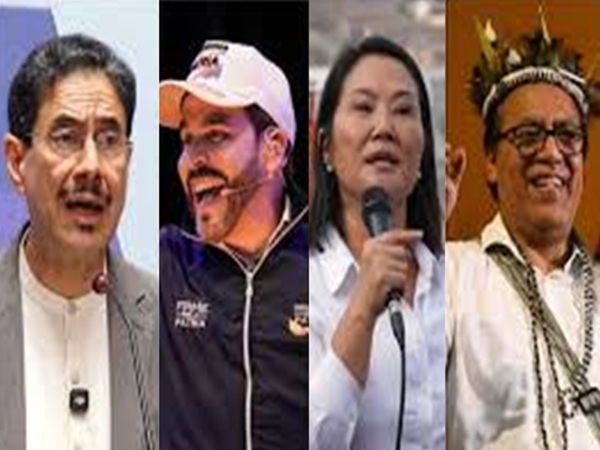
On the night of Sunday, June 21, just hours before the polls closed and without a final result, the right wing in Latin America celebrated Abelardo de la Espriella’s victory in Colombia. With a difference of barely 280,000 votes, less than 1% of the total, the right wing and its media outlets are trying to impose the narrative of Espriella’s triumph.
This is despite the various irregularities in the electoral process, such as the discrepancies in the voter registry reported since the first round, and Trump’s interference in the electoral process. Not to mention Espriella’s past as a lawyer for paramilitaries and a promoter of the use of firearms. Although on June 24 the final result was announced with de la Espriella’s victory acknowledged by Iván Cepeda, the small margin of votes points in the opposite direction to the apparent irreversible triumph of the far right.
Polarised elections
The situation in Colombia is not new in Latin America. Just two weeks ago, on June 7, the second round of elections was held in Peru between Keiko Fujimori, daughter of the dictator, and Roberto Sánchez, political heir of the recalled and imprisoned president Pedro Castillo.
The difference of a mere 40,000 votes between Sánchez and Fujimori, 0.23% of the vote, is far removed from the scenario constructed by the media before the first round on April 12, when Sánchez burst onto the scene among the 36 presidential candidates. This relegated the right-wing candidate Rafael López Aliaga to third place and dismantled the idea, constructed by the media and the continental right wing, that the second round would be between two right-wing candidates, as happened last year in Bolivia between Rodrigo Paz and Jorge Quiroga.
Espriella’s moderation during his electoral campaign is another example of how, despite his reactionary and aggressive rhetoric, he needed to attract a few thousand votes from those unconvinced by his conservative platform. This is very similar to José Antonio Kast’s concealment of his agenda in Chile, where he moderated his discourse compared to the 2021 elections in order to garner enough votes to secure his victory.
These examples contradict the analysis of an irrefutable triumph disseminated by the regional right and some media outlets. On the contrary, both examples show that this triumph is more apparent than real. Donald Trump’s blatant support is not only an open intervention to favor the right, but also a sign of its weakness, making it clear that it is incapable of winning on its own.
It is true that the right has won elections in some countries, but it still needs to face the test of public opinion to implement its program of attacks on the working class and the rollback of hard-won rights.
A test of forces
Therefore, we can foresee weak governments that will face mobilizations against the attacks they attempt to launch. This is compounded by a growing discrediting of their dependence on Trump, who has been quick to point out the support they have received in an attempt to underscore their debt to him. This further weakens these governments, making them even weaker than Milei’s administration.
Javier Milei’s attacks on hard-won gains and counter-reforms have been met with significant mobilization from the Argentine working class. Examples include the general strike in February against the labor reform, which saw widespread participation from Argentine workers, and the weekly mobilizations of pensioners demanding an increase in their pensions.
Contrary to the media’s portrayal of a powerful Milei government, this demonstrates its weakness, evidenced by the uncertainty surrounding the midterm elections. If Milei and his attacks have not been definitively defeated, it is not due to his strength, but rather to the lack of resolve on the part of the left and working-class organizations. A similar process is taking shape in Chile against Kast’s agenda; in both countries, the working class is far from defeated.
Struggle in Bolivia continues
The situation in Bolivia is a vivid example of what will happen in the near future if right-wing candidates actually win in Peru and Colombia. The capitalist offensive of Rodrigo Paz, who initially rejected a wage increase demanded by the COB (Bolivian Workers’ Center) to combat inflation and eliminated the diesel subsidy at the beginning of the year, unleashed a wave of mobilizations comparable only to those of the Water and Gas War in 2000 and 2003.
The recent mobilizations, which began in early May, have paralyzed cities like La Paz and Cochabamba (see Bolivia, new mobilizations against right-wing attacks). In fact, on June 20, Paz was forced to declare a state of emergency in Bolivia due to his inability to restore normalcy, despite the strategy of attrition he has employed to quell the protests. This makes it clear that despite Paz’s electoral victory last year, he does not control the political situation in his country.
The same could happen in Peru if Keiko Fujimori wins the recent elections, as her policies will still need to be tested in the streets. This is also the scenario that the president-elect, Abelardo de la Espriella, will inevitably face in Colombia.
Mobilizations against the far-right
Therefore, rather than the advance of the far right in the region, as some analysts and leftist organizations have characterized it, we are facing a political impasse. An apparent stalemate, in which leftist parties are losing power to far-right candidates, who also cannot impose their policies without facing large and powerful mobilizations.
This is explained not by a rightward shift of the masses in the region, but by the absence of a more decisive and combative policy from progressive governments in the face of big capital, monopolies, and landowners.
A clear example has been the lack of support for the general strike called on February 19th by the CGT in Argentina against Milei’s labor reform. Despite having around 95% participation from workers—that is, the vast majority of the Argentine working class—the CGT, controlled by Peronists, did not promote any measures to continue or escalate the strike. On the contrary, only on June 16th, four months after the February strike, did they announce that they would promote a national march and a new general strike. However, there is no clear date for when these will take place.
Colombia
At the end of May 2025, something similar happened in Colombia when the proposed labor reform, which, among other things, shortened the workweek from 48 to 42 hours, faced right-wing obstruction in the Colombian Senate.
In response to this setback, President Gustavo Petro launched an initiative for a popular referendum to enact the reform by presidential decree. The Senate once again blocked the Popular Consultation in order to extract concessions from the Petro government during legislative negotiations.
But when the Consultation was presented by presidential decree from Petro and once again blocked by the Council of State, 95% of the country’s labor unions threatened to call a general strike throughout Colombia. This movement took even Petro’s own government by surprise, but ultimately forced the representatives of the bourgeoisie to capitulate, and a month later the Colombian labor reform was enacted.
Decisive resistance needed
This demonstrates not only the strength of the mobilized working class in achieving its rights, but also the limitations of parliamentary politics that are not based on the mobilization of workers.
Cepeda’s defeat shows the same conclusion: it is not enough to denounce the right wing; without the active mobilization of the working class, it is difficult to reverse the results of an election.
Globally, we are witnessing a new offensive by the bourgeoisie and the right wing, faithfully represented by Trump, who has attempted to impose his will by force. However, the mobilizations against ICE in the United States make the path forward clear.
It is not through moderation that left-wing parties, unions, or peasant and indigenous organizations will be able to stop the attacks of the right wing, business owners, and landowners. It is through determined struggle in the streets, in neighborhoods, in cities, and in the countryside that the oppressed will not only be able to stop the attacks but also advance and achieve new victories.
In this regard, the example of Portugal is clear, where on June 19th, parliament rejected the labor reform after the far-right party Chega joined the left-wing bloc. Of course, this is not a product of Chega’s goodwill but rather the result of the enormous pressure exerted by thousands of workers in the mobilizations of recent months, which have included two general strikes in six months.
The extreme right is neither all-powerful nor invincible, as it tries to portray itself and is portrayed by the media. Despite its bravado and arrogance, the far right can not only be defeated but forced to retreat through a clear program that unites and mobilizes the majority of workers, women, the LGBTQ+ community, peasants, and Indigenous people with clear demands. But promises are not enough; if they don’t materialize, as has unfortunately happened in Chile, Argentina, Bolivia, and Colombia, the far right can grow, feeding on disillusionment.