This article can be read in Spanish here.
For the past three weeks, thousands of workers and farmers in Bolivia have brought the country to a standstill, protesting the hydrocarbon crisis and inflation caused by the government of Roberto Paz. The mobilizations led by the Bolivian Workers’ Central (COB) demanding a wage increase to combat the impact of inflation, which hovers around 15%, were joined by protests from farmers and transport workers against the elimination of the diesel subsidy.
Protests in Bolivia have intensified in recent weeks due to a combination of economic crisis, privatizations of the agricultural sector, economic concessions to US imperialism, fuel shortages, inflation, and political tensions between the government of Rodrigo Paz, the Movement for Socialism (MAS), and the main labor and peasant organizations.
The mobilizations began in early May with wage demands from the Bolivian Workers’ Central (COB) and the Tupac Katari Peasant Federation (FPT). However, they quickly evolved into nationwide blockades. Faced with the government’s refusal to engage in dialogue and its repression, protesters have demanded the resignation of Rodrigo Paz. The protests have paralyzed strategic highways and disrupted the supply of food, gasoline, and medicine in La Paz and throughout the Chaco region.
In recent days, tensions have escalated with massive clashes between workers and police forces in downtown La Paz. The government is accusing groups linked to Evo Morales, the coca growers’ union, the COB (Bolivian Workers’ Center), the FCTK (Federation of Workers of Kuczynski), and the MAS (Movement for Socialism) of terrorism while launching a witch hunt against union leaders, Indigenous people, and political activists. This comes after the massive popular protests of May 18th that swept through wealthy neighborhoods of La Paz. At the time of writing, there are 90 people detained, 4 killed by police, and hundreds of arrest warrants issued, one of them against Mario Argollo, the main leader of the COB.
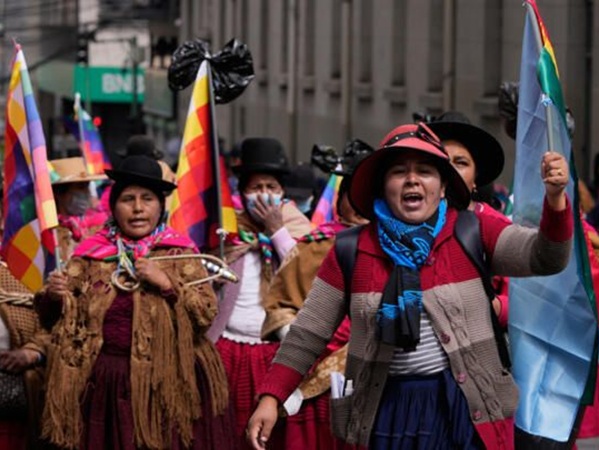
Although the government recently repealed the controversial agrarian law in an attempt to quell the conflict, protests continue and are expanding with the participation of Indigenous, peasant, and transportation organizations. Despite the repression, other groups, communities, and grassroots organizations have joined the mobilizations. The Red Ponchos, an organization of Aymara peasants and Indigenous people historically linked to the leadership of Evo Morales, is leading and expanding the mass mobilizations in the La Paz highlands, echoing the call for a general uprising of the 36 Indigenous nations that make up Bolivia. Alongside the Red Ponchos, thousands of miners, teachers, peasant women, and students are also taking to the streets to protest privatization reforms, cuts to social subsidies, and the rising cost of living.
The proletariat in Bolivia
It is inspiring to observe, through the news, the level of organization and militancy of the workers’ and peasants’ organizations that are currently challenging the Paz government, a puppet of US interests and the country’s racist oligarchy. However, this situation is not new, as the dynamics of events recall the historic struggles waged in 2001 and 2003, during the Water and Gas Wars, when labor and peasant organizations led a series of popular uprisings against the privatization policies of natural resources, culminating in the MAS party’s victory in the elections.
In this way, they marked the beginning of a profound political transformation in the country and redefined sovereignty over natural resources for the benefit of the most disadvantaged classes. For more than a decade, their political influence was decisive in the wave of progressive governments in the region. However, the programmatic limitations of Evo Morales’s government, which focused on developing Bolivian capitalism and the Andean bourgeoisie, ultimately led to the crisis of the MAS party, its defeat in the last elections, and Paz’s victory.
It is no coincidence that these mobilizations are being led by tin miners, who have historically been one of the most combative and organized sectors of the Bolivian working class. This phenomenon is a result of the unique development of the extractive economy of the Altiplano, as well as the pressures and exploitative conditions under which miners and peasants have historically lived, subjected to the threat of imperialist powers and the social contempt that the Bolivian oligarchy has exercised for centuries against Indigenous peoples. This context has been the revolutionary ferment that, since the peasant and workers’ wars of the 19th century, has forged this distinctive characteristic of militancy in one of the most exploited, plundered, and oppressed social classes in Latin America.
This demonstrates that, beyond the electoral defeat of the MAS and Paz’s victory in November 2025, the working class and the indigenous peasantry have not adopted a passive or demoralizing stance, nor have they shown any sympathy for the right wing. On the contrary, and even despite the internal disputes within the MAS between Luis Arce and Evo Morales, popular organizations have led massive efforts that are pushing the process toward a general uprising like the one experienced at the beginning of the century.
Indigenous peoples and the anti-imperialist struggle
Contrary to any short-sighted analysis of the limitations of the current struggle, the centuries-old workers’ traditions of revolt, the nature of exploitation in the country, and the current composition of the protests are a testament to the power of the indigenous workers and the weakness of the oligarchy, the Paz government, and imperialism.
It is in this context that we must refer to the ways in which the capacity for action and leadership of the Bolivian working class is expressed. The popular assemblies organized from the grassroots of the COB—whose leadership, absent from the streets, is currently negotiating behind closed doors with Paz—maintain the road blockades and street protests in La Paz. This demonstrates the political potential of the working class in the face of the limitations imposed by its own leadership. It also opens the possibility of building broader alliances beyond the union sphere, such as those established with the Red Ponchos of the countryside.
The disappearance of the COB (Bolivian Workers’ Center) from the streets, as well as the absence of the expected miners’ column from Colquiri, raises concerns about a possible new betrayal and recalls what happened in January, when Argollo met with Rodrigo Paz’s pro-business government to draft a new austerity decree based on imposing a gas price increase on the working people. However, the example of the assemblies, the road blockades, and the actions carried out in relentless battles demonstrate the methods of struggle that the Bolivian proletariat must follow to guarantee the movement’s success.
The prospects for struggle in the medium term
Bolivia is under a neocolonial and profoundly unequal regime, whose political and economic structure continues to reproduce historical forms of exclusion against Indigenous peoples and peasants. In this context, the burning and trampling of the Wiphala flag by officials and supporters of President Rodrigo Paz during Monday’s protests is not an isolated incident, but rather a direct attack against one of the central symbols of the country’s plurinational identity. The Wiphala represents much more than a flag: it expresses the historical memory of resistance of the Andean peoples, their right to self-determination, and the assertion of a national character built from the ground up by the Indigenous and popular majorities.
As René Zavaleta Mercado, a Bolivian revolutionary and Marxist, stated, “When the proletariat mobilizes politically, they are the nation.” This statement encapsulates a Bolivian historical tradition in which great popular uprisings—Indigenous, working-class, and peasant—embodied the national project in the face of a bourgeoisie historically subordinated to foreign capital and deeply contemptuous of everything linked to the plebeian and Indigenous nation. From the mining oligarchy to the business sectors that are currently supported by the Paz government, this ruling class has repeatedly conceived of Bolivia not as a sovereign nation, but as a space of dependent administration.
In this sense, the Wiphala flags, miners’ helmets, and red ponchos embody much more than identity symbols: they represent the age-old historical demand of a class that understands the nation through a communal, anti-imperialist, and socialist consciousness. This is a political tradition that has permeated the great Bolivian insurrections—from the Indigenous rebellions of the 19th century to the miners’ and peasants’ uprisings of the 20th century—and which today is once again at the heart of the political and social struggle against those who seek, once more, to dismember the Bolivian nation. While the movement today does not advocate for the struggle for socialism, its embodiment lies in the struggle for the emancipation of the Indigenous nation.
The attack against this emblem reveals the reactionary nature of the Bolivian right wing, which, while invoking a discourse of “pacification,” deploys practices of racial hatred and political violence against the popular sectors. In this sense, the defense of the wiphala and the existence of Indigenous nations also takes on an anti-imperialist character. Lenin maintained that the nationalism of oppressed nations could assume a progressive character when confronted with imperial domination and the structures of national oppression imposed by the powers and the local elites subordinated to them. In the current situation, the Indigenous and popular reclamation of the wiphala in Bolivia does not express an exclusionary nationalism, but rather a political affirmation of historically subjugated sectors against the interference of US imperialism and the dominant classes that act as its intermediaries. Today, in the streets, the wiphala is once again becoming a symbol of resistance against racism, neoliberal austerity, and subordination to US capital.
An internationalist and anti-imperialist perspective is needed
At a time when the class struggle in Bolivia is once again ushering in a new cycle of worker and popular revolt, the overthrow of Rodrigo Paz’s government and the oligarchy remains the central slogan driving the mobilizations and likely to accompany the upcoming battles in both rural and urban areas. However, the political course that the movement might take in the event of a victory is still undefined. Although sectors of the working class and peasantry maintain hopes for a possible return of the Movement for Socialism (MAS) and Evo Morales to power, this prospect now appears distant and limited by the deep internal disputes within the party and the accumulated erosion of its historical leadership. In this context, the possibility is emerging of new left-wing organizations and leaders capable of overcoming the political and strategic crisis currently facing the Bolivian popular movement.
The demands that are currently being voiced in the streets—the defense of nationalizations, a general increase in wages, the recovery of strategic resources such as tin and lithium, the rejection of neoliberal austerity measures, and the expulsion of imperialist interference—will hardly be achieved under the current leadership of the MAS and the COB.
Their realization will depend on the emergence of a new leadership forged organically in the struggle, capable not only of defeating the government but also of overcoming the limitations imposed by the conciliatory leaderships that have contained the radicalization of the working class and peasantry. Only by returning to an internationalist and anti-imperialist perspective, linked to the defense of the social gains achieved during the popular upsurge of the MAS years and subsequently dismantled after the coup d’état led by Jeanine Áñez, can the path be opened for the development of a new revolutionary left in Bolivia, based on the self-organization of the masses and the political independence of the workers and Indigenous peoples.
In this context, the protests also represent an opportunity to reopen a political horizon of social transformation for the entire region. If this process consolidates, it could become an example of continental resistance and revitalize popular struggles against the rise of far-right governments in countries like Chile, Ecuador, Argentina, and El Salvador.