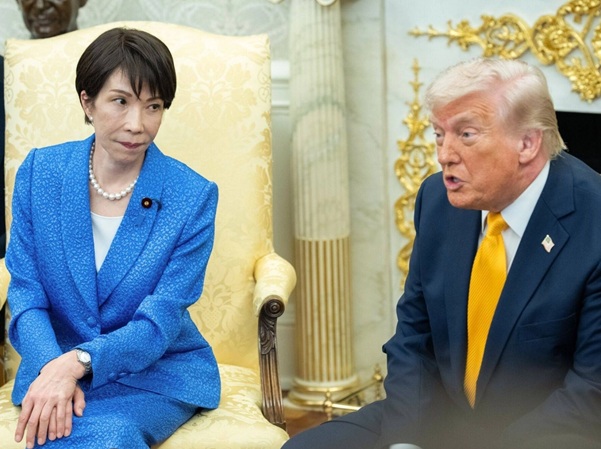
The Trump administration recently approved and implemented measures to support the Yen. Our correspondent spoke to Iri in Tokyo, a member of the Shinjuku General Workers’ Union (Zenroren) about how she views the situation.
The Trump administration’s decision to join Japan in supporting the yen is very important, both for the Trump administration itself and for the new Takaichi government here. It illustrates a further deepening of economic and political coordination between Japanese and US imperialism.
The weakness of the yen has several causes. One of the most important immediate factors is the continuing interest-rate gap between Japan and the United States, which encourages yen-funded carry trades. This interacts with the longer-term legacy of an extremely accommodative monetary policy and concerns about Japan’s fiscal position. Currency intervention may temporarily support the yen, but it cannot by itself resolve these underlying pressures.
Japan/US interdependence
Japan remains the largest foreign holder of US government debt, with more than $1 trillion in US Treasury securities. If Japan were forced to sell large quantities of Treasuries in order to finance repeated intervention to support the yen, this could put upward pressure on US Treasury yields and increase US borrowing costs. The United States therefore also has an interest in preventing a disorderly yen crisis.
I would define this kind of relationship as asymmetrical interdependence within imperialism. The United States remains much stronger than Japan politically and militarily, but their financial systems and capitalist interests are nevertheless deeply interconnected.
The situation should also be viewed from a political, developmental perspective. The Japan/US relationship is strong, but American imperialism is now facing a difficult situation in Iran and the Middle East, as well as being gradually pushed out of the global market by countries such as China. This is at a time when many Americans already feel the negative effects of Trump’s policies particularly in the run-up to the mid-term elections.
The US, until now, has used the overwhelming power of the dollar and its ability to access international markets to allow the American capitalist class to expand internationally by building global companies and making large profits in the process.
One challenge it faces is the emergence of a new payment network led by BRICS based on the yuan. The US’s influence based on the international dollar is undoubtedly weakening. In such a situation, one option the US can use to bolster support for the dollar is to lean on those countries such as Japan where it can easily exert economic and political influence.
Two-way capital flow
Japan and America are deepening their economic and political ties. As part of the tariff agreement, Japan has committed to mobilising up to $550 billion through investment, loans and guarantees for strategic projects in the United States. Japanese state institutions such as JBIC and NEXI are involved alongside private banks and corporations, while SoftBank is an important example of the growing integration of Japanese capital into US AI technology and infrastructure investment.
At the same time, capital moves in the opposite direction. Large US-based investors are also making major investments in Japanese AI and data-centre infrastructure; Blackstone is one clear example. I would describe this as a form of state-mediated reciprocal capital export: capital export between advanced capitalist powers that is actively organised or supported by states. I think this provides an interesting contemporary form of the classical problem Lenin identified around finance capital and capital export.
While Japan’s export industry in general benefits from the cheap yen, Japan’s auto-industry, suffering from Trump’s tariffs and serious competition from more technologically advanced Chinese manufacturers, is in a quite catastrophic state. It is perhaps only the weak yen that is providing a lifeline.
It is for these reasons that Takaishi, alongside a large section of the financial and industrial capitalists and Liberal Democratic politicians who dominate Japanese politics see yen depreciation as beneficial, particularly as it attracts investment from US IT companies.
I think this is an important point when discussing modern imperialism. Capital export should not be understood only as a one-directional movement from imperialist countries towards the Global South. Accumulated direct investment is heavily concentrated in advanced economies, and investment between advanced capitalist economies is itself a major part of the global stock. Mutual capital export between advanced capitalist economies therefore remains a major structural feature of contemporary capitalism.
Meanwhile, ordinary people, the working class suffer by having to pay extra for imports – mainly domestic goods and foodstuffs. Inflation is accelerating.
Data-centres
The large data centres I have already mentioned are an example of this incoming investment. AI is developing extremely rapidly, although its deep integration into Japanese workplaces is still relatively limited, so many of its consequences for employment and working conditions are only beginning to emerge.
These projects include plans to build ‘mini-nuclear’ plants to power them. Despite running out of storage space for spent nuclear fuel, the country has been reopening its nuclear energy reactors, most notably the TEPCO owned Unit 6 at Kashiwazaki-Kariwa, which has been shut-down since the earthquake and tsunami fifteen years ago.
At the same time Defence Minister Shinjiro Koizumi has been calling for a discussion about nuclear deterrence and nuclear weapons “without taboos”. This is despite there still being a strong anti-nuclear movement in Japan, particularly to the use of nuclear weapons. The opposition has been side-lined by parliament, including by most opposition parties who support the re-opening of the nuclear plants.
Some communities are already raising concerns about the environmental and social consequences of data centres. The problem is that these struggles remain fragmented and localised. There are movements against particular construction projects, against nuclear power and against other forms of environmental destruction, but they are not yet sufficiently connected into a broader nationwide movement.
I think one important task for the left is to connect these local struggles to a wider politics of climate justice, and to show how questions of energy, development and environmental costs are connected to capitalism and imperialism. The question is not simply whether development takes place, but who benefits from it, who bears its costs, and who has the power to decide.