American capitalism is entering an epoch of monstrous imperialism, of uninterrupted growth in armaments, of intervention in the affairs of the entire world, of military conflicts and convulsions.
Trotsky, November 1931
In the immediate aftermath of Trump’s first election in 2016, the American left witnessed what appeared to be an historic resurgence. Shortly after Trump’s inauguration in 2017, membership of the Democratic Socialists of America (DSA) soared to over 17,000, an incredible surge for an organization that only a few years prior had been little more than a relic populated by Socialist Party of America dissidents. Socialist Alternative (SAlt), then the US section of the Committee for a Worker’s International, also grew rapidly, moving towards its historic peak of around 1000 members. Likewise, the Neo-Stalinist organization, the Party for Socialism and Liberation (PSL), also saw unprecedented growth.
The lead-up to the 2016 general election was defined as much by Trump as it was by the meteoric rise, and successful suppression of Bernie Sanders and his insurgent campaign. Bernie Sanders, the longest serving independent member of Congress, launched his campaign for the Democratic party presidential nomination in 2015.
By most accounts, Sanders, who described himself as a “democratic socialist” and espoused a limited social-democratic platform, was completely unprepared for the popularity of his campaign. His 2015 campaign was likely meant to pressure the Democratic Party to embrace some reformist policies, such as universal healthcare. Instead, Sanders rapidly found himself at the helm of a movement that stood a real chance of competing with Hillary Clinton, the Democratic Party’s chosen successor to Obama.
Sanders did not campaign on a revolutionary, or even particularly transitional platform. His decision to run within the Democratic Party, severely limited his ability to create any sort of coherent movement or organization from his campaign. Nevertheless, the Bernie Sanders campaign has had an immense impact on the political environment of the United States. It is indisputable that the Sanders campaign played a critical role in normalizing socialism, at least in concept, in the mind of the typical working class person in the United States.
Resistance during Trump 1.0
The first Trump administration also saw what seemed to be a reawakening of militant labor unionism. In 2018, a historic wildcat strike by West Virginia teachers shook the labor establishment and the nation overall. In January 2019, Sara Nelson, president of the Association of Flight Attendants under the Communications Workers of America (CWA), called for a general strike and endorsed wildcat actions that would have grounded commercial air traffic nationwide, thus successfully forcing an end to what was at the time the longest government shutdown in US history. In 2020, predominantly Black workers in Bessemer Alabama, inspired by the Black Lives Matter protests, launched one of the first union drives at an Amazon facility.
2020, the last year of Trump’s first term, was marked by civil unrest. On May 25th, 2020 George Floyd, a Black man, was murdered by police in Minneapolis. Police killings are common in the US, and often spark protest, but rarely to this scale. More than 15 million people took to the streets in the largest, most sustained, and most violent uprising in a generation. In addition to the semi-spontaneous mobilization of millions of workers and youth, some of the protests took on a legitimately insurrectionist character. In Minneapolis, community members forced the police to abandon the 3rd Precinct building, seized it, and set it ablaze. Amalgamated Transit Union (ATU) Local 1005 in Minneapolis refused to allow its members to participate in driving buses to transport either police or prisoners. In Seattle, protesters forced police to retreat from the East Precinct building, and established the now infamous occupied protest CHAZ/CHOP.
The suppression was equally historic. The level of state violence used to suppress the George Floyd Uprisings easily surpassed that used against 21st century movements such as Occupy or the Iraq War protests of 2003. In Seattle’s Capitol Hill, police deployed so much tear gas that it contaminated local water supplies. In Washington DC, protesters advanced on the White House and caused Trump to flee to an underground bunker. Military-style riot tactics were implemented on a scale not seen since the Civil Rights struggle of the 1960s, and US intelligence forces were deployed nationwide under “Operation Legend”. The aftermath of the uprising left dozens dead — killed both by state forces and by far-right Trump-supporting militias and vigilantes.
Trump’s first campaign shocked the US establishment and the country as a whole. Huge numbers of working class people were outraged at Trump’s open racism and misogyny, which far surpassed what had previously been acceptable in mainstream discourse. This was reflected in the approach that the socialist left, especially SAlt, took towards recruitment. In the short term, this was successful. Trump’s historic unpopularity in his first term, and the Democrat’s inaction, created ample room for a left alternative.
It has since become clear however that this approach was fundamentally flawed. Trump’s first government was historically unpopular, and it was correct to use this as a basis for recruitment. However, simply recruiting off of the basis of opposing Trump was not enough. A rigorous Marxist analysis of Trump’s first administration shows that the Trump government was, in most material respects, an escalation of Obama’s policy cloaked in the language of the far-right.
Trump results from the crisis of US capitalism
This reality should not be used to diminish the harm of the first Trump government, but rather to understand it, and the relationship that it had to radicalization.
The most striking example here is found when comparing the deportation rates between the first Obama administration and that of Trump. It cannot be disputed that the racist and white supremacist rhetoric under Trump was a frightening escalation. However, an analysis of pure policy shows that the basis of this escalation was built by the Obama administration. The first Trump administration deported about 1.5 million people from the United States, a staggering toll of human suffering. However, in the first term alone, the Obama administration deported 2.9 million, nearly twice as many.
The drastic escalation in racist rhetoric under Trump should not be dismissed, however, the simple facts show that in matters of policy the cold neoliberalism of Obama was quite similar. One particularly stark example is the Ursula “Detention Facility” in Texas. Bourgeois media frequently published images of migrant children held captive there in barbaric conditions. What was published less frequently was that the Ursula camp was opened in 2014, during the Obama administration.
This example in particular provides a key insight into the failure of the Marxist left to muster a real opposition. Trump was indeed a historically unpopular President in his first term, however, the point of dissatisfaction with him, particularly among the more privileged workers and youth, oscillated between a real opposition to policy and a vague sense of disgust towards Trump’s language. Obviously Trump’s language was and is disgusting, but that alone cannot form the basis of political organization.
Character of the opposition to Trump 1.0
In conjunction with Trump’s historical unpopularity, the increased interest in socialism during Trump’s first term was also driven by a broad feeling among workers that the Democrats were failing to fight Trump. This, of course, was true. While the Democrats rhetorically opposed Trump, they continued to largely vote in favor of his agenda. In 2020 for example, the Democrat majority House of Representatives voted 377-48 in favor of a $738 billion budget for Defense. Despite their consistent concessions to Trump’s policies, the Democrats rhetorically exploited the new cultural norms pushed by BLM and the #MeToo movements without doing anything to actually tackle the issues they were raising.
A key difference in the opposition to Trump’s administration in his first term as opposed to his second is that it was, at least at first, driven from the top down. In the early days of the Trump administration, a liberal manifesto called the “Indivisible: A Practical Guide for Resisting the Trump Agenda ” was published. It spread rapidly among liberals and quickly gave rise to an organization, predictably called “Indivisible”. The guide was touted as an example of grassroots activism. In reality, the authors were former Democratic congressional staffers.
Mass rallies such as the 2017 Women’s March offered an outlet and a sense of purpose for people both frightened by Trump and dissatisfied with the performance of the Democrats in 2016. Both saw genuinely impressive levels of participation, Women’s March saw more than half a million people gathered in Washington DC alone, the largest such gathering in decades.
The political platform of Women’s March was respectable, identifying issues such as white supremacy, a living wage and socialized healthcare as essentially feminist. Though not revolutionary or anti-capitalist in character, the political positions were genuinely reformist, at least in rhetoric. However, any potential that Women’s March had rapidly dwindled. As is often the case, the combination of top-down organizing and electoral focus around the Democrats meant that Women’s March, like Indivisible, never had any chance of developing into a coherent movement, instead being funneled into voter outreach to elect more bourgeois politicians.
Opposition to Trump 2.0
Regarding protest movements in Trump’s second term, the ‘No Kings’ protests are the obvious point of comparison to the Women’s March. The level of participation in the October 18th No Kings protest dwarfed not only the Women’s March, but indeed most single day protests in US history. Reasonable estimates put the number of participation nationwide upwards of 5 million, while the organizers claimed 7 million.
Yet where Women’s March had a radical, if vague, platform, No Kings has no platform whatsoever. Outside of a stated commitment to non-violence and ruminations on the color yellow, their website contains no political positions or platform. No serious observer genuinely believes Trump intends to install himself as a monarch, and yet, the No Kings movement is so lacking in political character that it cannot even commit to its own name. On the 14th of June, American expats and sympathizers gathered to protest at the US embassy in London. This protest bore the name “No Tyrants”, so as to avoid any anti-monarchist sentiment offending Charles III and the house of Windsor. This ironic position illustrates how No Kings views Trump himself as the problem, and draws no connection to political systems.
Moving past the strictly political failures of the No Kings protests, there is another critical concern: that of the generational makeup of the protesters. Various commentators, bourgeois and otherwise, have correctly identified that the majority of participants in the protests are ‘Baby Boomers’ those born in the US between 1946 and 1964. The youngest of this generation are past sixty, and the oldest are approaching eighty.
The “Gen Z” protests which shook the world in 2025 were largely composed of those born between 1997 and 2012, who range from their early to late twenties. While there was certainly participation in the No Kings protests by people of all ages, the contrast cannot be ignored. The No Kings protests not only failed to draw the youth, but struggled to attract middle-aged workers.
The Minneapolis struggle
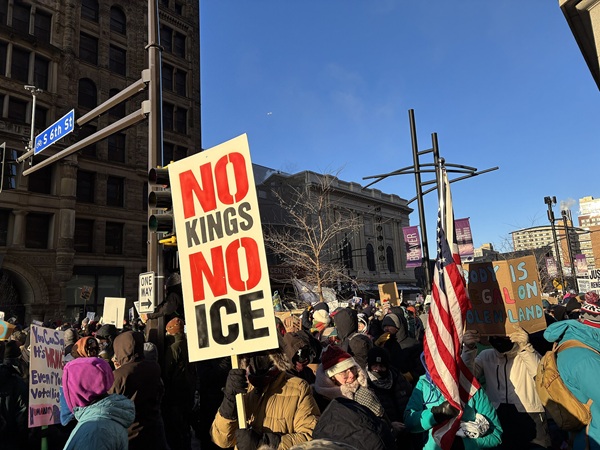
Although protests against Trump have been politically weak overall, there have still been tremendous struggles. The pinnacle of these in Minneapolis. Unlike the broader anti-Trump movements, the resistance in Minneapolis, and a lesser degree, St. Paul, was in opposition to an extremely specific and extremely visible action by the Trump government.
As part of his campaign promise to persecute undocumented immigrants, Trump launched several ICE operations starting in mid to late 2025. Operation Metro Surge saw at least 3,000 paramilitarized ICE and Customs and Border Patrol (CBP) agents to Minnesota, primarily in Minneapolis. The operation served two purposes. As part of a larger deployment of federal security forces, it fulfills Trump’s promise to his base to “crack down” on imagined crime related to immigration. The second purpose was to punish the workers and oppressed people of Minneapolis for the uprising in 2020. The second purpose of the operation was made extremely clear. Polling suggests that upwards of 25% of adults in Minneapolis, regardless of citizenship status, experienced some sort of harassment or abuse from ICE or CBP agents. The behavior of the security forces was undisciplined by design.
The indiscriminate and provocative nature of Operation Metro Surge was self-sabotaging, as it drew in broad swathes of the population outside of the immigrant community and committed activists. Notable attention was given in bourgeois media to the role played by “middle class” white suburbanites in the Minneapolis resistance. The tactics used by the ‘resistance’ were also given a surprising degree of cover in bourgeois media. “Mutual Aid” is a term often repeated among the left in the US, typically in the context of charity bannered in either red or black. In Minneapolis however, mutual aid networks showed their true form, maintaining threads of survival outside of state structure.
As was the case during the 2020 uprising, the protests and resistance in Minneapolis took on a militant character. Activists in Minneapolis monitored and physically tailed ICE vehicles and agents, providing updates on their whereabouts, and inhibiting their ability to operate. They set up roadblocks and check points to block ICE from entering neighborhoods, and asserted physical control of their communities.
The resistance to Metro Surge culminated in the “Day of Truth and Freedom” protest on January 23rd, more commonly referred to as a ‘General Strike’. The protest took place on a workday, but still mobilized roughly 75,000 people despite temperatures below -10C. This was a huge level of participation, equivalent to around ⅓ of the work force of Minneapolis, and it demonstrated how deeply popular the movement was. The protest was not, however, a general strike.
Labor played a role to be sure. The Minneapolis AFL-CIO endorsed the protest, and encouraged members to attend. They did not, however, actually engage in any strikes, which would have meant holding democratic votes among membership, forming strike committees, and maintaining pickets. This is the difference between a protest in which labor participates, and a strike in which labor exercises political and economic power.
The resistance in Minneapolis was also overshadowed by the murders of two protestors, Renée Good and Alex Pretti who were killed on January 7th and January 24th respectively. It was only after the murder of Pretti, a day after the “Day of Truth and Freedom” protests that the Trump administration began to wind down the operation. Even if the Trump administration had already decided to avoid overplaying it hand before the protests, the scale and militancy of the opposition left it with no option than to retreat.
Opposition to genocide
Returning to the topic of protest movements in general, there is another factor to be considered, that of the genocide in Gaza. During Biden’s administration, protests against the genocide made headlines, and students at universities across the country set up occupations in public spaces. However these protests were quickly and firmly suppressed, and thus far no other movement has picked up the momentum. In particular the No Kings approach to the genocide has been ambivalent, solidifying its position as a non-starter for the radical sections of Gen Z in the US.
The genocide in Gaza is the first crime of this magnitude covered live in the age of social media. This is due primarily to the heroic efforts of Palestinian journalists, who document and broadcast the genocide in real time, even as Zionist forces assassinate their colleagues by the hundreds. The result is that youth today see not only video footage of US-sanctioned atrocities, but are able to communicate with the survivors in Gaza.
The influence of social media is not one-sided, Zionist soldiers also use social media extensively to boast of their crimes. Despite the growing outrage, Democrats have largely doubled down. Biden made unconditional support for the Zionist State a cornerstone of his presidency, funneling some $20 billion in military equipment after October 7th, a policy Kamala Harris indicated she would likely continue.
This is not to suggest that the average youth in the US is motivated to political action primarily by the genocide in Gaza. But for the most politically developed young workers, solidarity with Gaza is a fundamental baseline. This rapid change would seem to open a new avenue for the revolutionary left to boldly intervene and to recruit working-class students and young people with an anti-genocide, anti-imperialist platform. For the most part, this has not occurred. This can be attributed in part to the Red Scare style suppression to which pro-Palestine movements are subjected.
Another likely cause is that revolutionary left organizations lack the capacity and connection to play a useful role in the struggle. In the case of Socialist Alternative, the ability to meaningfully intervene is sabotaged by an incoherent and backwards platform. SAlt declined to use the word ‘genocide’ until fairly recently. The justification for this position is bizarre. While it has its roots in a bastardized analysis of work by Matzpen, SAlt’s position emphasises the role of Jewish workers in the Zionist State, and defending their “democratic rights”. This position is both incorrect and generally off-putting. Even if SAlt attempted a meaningful intervention this wrong position will turn away most people in the Palestine solidarity movement.
Growth of the reformist left
Where the revolutionary left has failed to make an impact, the reformist left has surged forward. The DSA now boasts over 120 thousand dues paying members, a net gain of more than 100 thousand since their initial growth in 2017. According to DSA, around half of these members have joined just in the last year. In November of 2025, they scored perhaps their greatest victory since 2019, with the election of Zohran Mamdani as mayor of New York City.
A Democrat and member of DSA, Mamdani easily overtook establishment Democrats Eric Adams and Andrew Cuomo in an upset victory for mayor of the USA’s largest city. As a Democrat, Mamdani’s platform was reformist and social-democratic, but still bitterly resisted by the Democratic Party and bourgeoisie of NYC. An Indian-Ugandan immigrant and Twelver Shia, Mamdani ran a campaign as an open anti-Zionist in a city with more Jewish voters than any other in the world, including cities in the Zionist State. Moreover, approximately 1/3 of Jewish voters in New York City voted for him. These results draw into question the assertion by mainstream Democrats that support for the genocide and the Zionists is somehow critical to electoral victory.
Mamdani has proven to be a wildly popular leader. His focus on quality of life issues has allowed him to quickly rack up wins, and recent polling suggests his popularity continues to grow. In the recent Democratic primary in New York, DSA members endorsed by Mamdani won two key primaries. Darializa Avila Chevalier and Claire Valdez are now all but guaranteed to win their general elections in November, as is Brand Lander, an ally of Mamdani but not a DSA member. Merely seven months from his inauguration Mamdani has established himself as a political kingmaker in NYC, and his influence is sure to grow.
It is clear that Mamdani is an exceptionally talented political leader, but this alone will not be enough to resolve the political contradictions within DSA. Mamdani ran as a Democrat and refers to himself as such. If he sees an inherent conflict between “democratic socialism” and the Democratic party, he does not express it publicly. In fact, he has said the opposite, a position which if not completely unsupported within DSA, is certainly not held by the plurality of the organization’s members.
Mamdani has also shown a predilection for making concessions where he does not need to. Per his campaign platform, Mamdani pledged to open a city-run ‘direct-care clinic’ providing hormone therapy for transgender New Yorkers. Yet this initiative has been unnecessarily watered down by Mamdani’s government unilaterally adopting the age criteria proposed by the Trump administration, which will deny care to anyone under nineteen. This concession was not made in response to any sort of legal pressure, but rather was preemptive, conceding to something that Trump might do without any fight.
The issue of police reform has been Mamdani’s most prominent failure so far. Even before his inauguration, Mamdani stated his intention to keep on Jessica Tisch as police commissioner. Tisch, a billionaire heiress, was appointed to police commissioner by Eric Adams, Mamdani’s predecessor, having previously been given a variety of bureaucratic positions through nepotism. In addition to generally being on the far-right of the Democratic Party, Tisch is also an open Zionist, and has made no secret of her hatred for the Palestine solidarity movement. What is more, Tisch has repeatedly used her position to publicly contradict and criticize Mamdani’s leadership. Not only has Mamdani not removed her, but he has committed to hiring more police officers, and repeatedly delayed his pledge to implement unarmed “Community Safety” personnel as an alternative. The failures and concessions of Mamdani’s government on the issue of police are so severe that NYC-DSA published an official criticism.
Democratic elite tail-ending Trump
Since taking office for the second time, Trump has made genocidal transphobia and anti-trans policy a key aspect of his administration. The attacks on trans healthcare by the Trump regime are devastating, and the intended outcome is almost certainly a drastic increase in deaths of trans youth.
This should not come as a surprise. The far-right has successfully manufactured a moral panic against trans people centered around either “grooming” children, or women’s sports. The far-right has developed a peculiar obsession with youth sports, resulting in coordinated harassment campaigns against young trans girls. While the accusations leveled by the right are patently absurd, absurdity has rarely swayed the bourgeois liberal establishment against falling into line with fascist rhetoric and policy.
For years now, the New York Times, the US paper of record and liberal titan, has published opinion pieces lending credence to right-wing attacks on trans people. Almost immediately after Trump’s victory in 2024, prominent Democrats began suggesting that the Democratic Party had alienated voters by adopting a ‘radical’ position on trans rights. California governor Gavin Newsom, a Democrat widely viewed as a likely contender for the presidency in 2028, has gone even further, regurgitating far-right transphobic talking points, and pursuing aggressively anti-trans legislation.
Trump’s imperialist aggression
On the international stage, the Trump regime has pursued a policy of unprecedented transparency in the motives for its imperialist aggression. In his first year in office, Trump and his regime have made clear that longstanding red lines seemingly no longer apply.
The lone exception perhaps being in Trump’s dealing with the Zionist State. Biden’s policy of unconditional support is incompatible with Trump’s personal instability and posturing, resulting in Trump taking a harsher, if still totally supportive, position. Trump’s desire to be seen as a peacemaker, and his disregard for diplomatic norms resulted in him pressuring the Netanyahu regime into a ceasefire deal. The ceasefire is of course lopsided, with the Zionist State adhering to a policy best described as “you cease, we fire”. Even so, this is still a notable difference from Biden’s policy.
On June 22nd 2025, the Trump regime made tangible a decade-long threat of US imperialism by launching a series of bombing missions against Iran’s nuclear energy program. Though the outcome of the strikes remains unclear, it seems that the damage done to Iran’s nuclear facilities was limited, and the nuclear program was not substantially delayed. Despite the results, the flagrancy of a direct attack on Iran deeply rattled the global political order. Within the United States, the reaction was muted. Democratic leaders made token statements about Trump’s overstepping of congressional authority, but offered no real resistance.
In the early morning of January 3rd, 2026, US forces launched an overwhelming assault on Caracas, Venezuela. Facing suspiciously little resistance from Venezuelan armed forces, US commandos, assisted by hundreds of aircraft, attacked Fuerte Tiuna, a Venezuelan military base, abducted Nicolás Maduro and his wife, Cilia Flores, executed his personal guard, and flew Maduro and Flores back to New York to face fraudulent charges of drug trafficking.
The attack on Venezuela established a new era of western imperialism and Neo-colonialism. Addressing the nation later in the morning, Trump and his cabinet freely admitted that their motivation for attacking Venezuela and abducting Maduro was to establish US control of Venezuelan oil reserves. Specifically, Trump outlined a plan to place the entirety of Venezuela’s oil under the direct control of US corporations, with the profits to be used to ‘reimburse’ the US for oil supposedly stolen by the Bolivarian government.
Trump’s crude justification for the attack so far seems to be satisfactory to the American public. Polls suggest that 1/3 of Americans support his actions against Venezuela. Among his base, support is even greater; 65% of Republicans polled approve. Meanwhile, organized opposition is minimal. Zohran Mamdani stated he had called Trump to voice his opposition, but despite Maduro being held in New York City, Mamdani has not used his platform as mayor to call for protests or labor action. Protests overall have been limited in number, and largely organized by Neo-Stalinist parties and their front groups. The exact relationship between the surviving PSUV administration and the Trump regime remains murky, though it seems to be the case that Delcy Rodriguez is acting as a proxy for Marco Rubio, Trump’s Secretary of State.
Attack on Iran
On February 28th 2026, the US and the forces of the Zionist State launched an unprovoked attack on Iran, escalating the regional crisis to open war. The conflict began with a combination of decapitation strikes and terror bombings. The initial wave of attacks killed Ayatollah Ali Khameini, his daughter, son-in-law, daughter-in-law, and infant granddaughter. Other targets included Islamic Revolutionary Guard Corps sites, and an elementary school in Minab, where at least 120 children were killed by US missile strikes.
Since the start of the war in February US and Zionist attacks have killed over 1,500 Iranian military personnel, and even larger numbers of civilians. Iranian civilian infrastructure has suffered tremendous damage, and will take years, and billions of dollars to repair. However, there is very little indication that Iran has suffered lasting damage to its military infrastructure.
The war has in many ways strengthened the Iranian regime internationally and at home. Iran has demonstrated the success of their military model. Despite the terror bombing campaign, Iran continues to produce missiles and drones in sufficient quantities to replenish their stockpiles. Their dispersed and semi-decentralized network of launch sites has allowed them to continue striking the US and its proxies throughout the Persian Gulf. Iran has not merely survived the US campaign, but strengthened their position.
The Iranian military, under the leadership of the IRGC has repeatedly demonstrated that the US is unable to defend its allies in the Gulf. Iran’s control of the Strait of Hormuz, long discussed as a hypothetical, is now the status quo. The closure of the Strait has had immediate consequences for global energy infrastructure. In the United States, gasoline prices have increased by more than 30% since the start of the war. The US is also facing shortages of non-fuel petroleum derivatives, like fertilizer and industrial oils.
The inability of the US to achieve a military victory over Iran resulted in the Islamabad Memorandum, a “memorandum of understanding” which led to a roughly month-long ceasefire. If implemented, the memorandum would have been an effective capitulation by the United States, a situation obviously unacceptable to the American bourgeois class, and this resulted in the resumption of hostilities in early July.
As it now stands there is no viable way for the United States to achieve a military victory in the war against Iran. Ending the war on Trump’s terms would require a massive amphibious assault and ground operations, not to mention prolonged occupation. This would result in horrific US casualties, and there is no guarantee that the US could accomplish it at all.
By every indication the war against Iran is wildly unpopular, yet it is internal concerns, rather than meaningful resistance that informs Trump’s hesitancy to commit fully to the conflict. In contrast to the wars in Iraq and Afghanistan, there have been no major protests or actions against the war. Democrats in government have made paltry efforts to restrict Trump’s authority, to limited effect. To an extent the lack of opposition can be attributed to the way the war has been waged. Trump has not made any effort to manufacture consent for the war, and has so deprived the left of the ability to develop refutations of his arguments.
Militant organisation and a revolutionary alternative is needed
The main factor though is that the war has not had a strong enough impact at this stage on the average worker to cause a large-scale mobilization. Regular price increases for essential goods have been normalized, as have constant bombing campaigns. In the absence of substantial American casualties there are no aspects of the war which would automatically cause mass unrest.
Overall, the political atmosphere in the United States is one of falling in line. In comparison to the first Trump government, opposition is minimal from both the Democrats and the bourgeoisie. The early fears of recession due to Trump’s aggressive tariffs quickly evaporated, and the stock market is at a record high. Meanwhile, the Democratic party has largely abandoned the meager opposition of Trump’s first term in favor of a bitter complacency.
Even with an overwhelming DSA victory in New York City the forces of the revolutionary left are weaker now, and seeing less growth than they were at this stage in 2017. A Marxist analysis demands that we be realistic about the present political conditions in the United States. The reality is that the conditions are somewhat grim.
Despite soaring profits for Wall Street, the economy remains unstable. This contradiction demonstrates that despite the instability, capitalists are by and large confident in Trump to a degree they were not in his first term. The cost of living crisis continues to escalate, and inflation has not reversed. Furthermore, a great deal of the ‘economic growth’ in the US is based on incredibly precarious investments and futures trading on the emerging AI market, which has yet to show true potential for profit long term. Official unemployment is fairly low, hovering just above 4%. Youth unemployment though is far higher, at just over 9%.
The lack of organized opposition to Trump in the current period makes intervention by Marxists difficult. With the exception of Minneapolis, large scale protests, where they have occurred, lack a political character, and organized working class participation. The left is also in an incredibly weak position, having failed to maintain momentum during the Biden administration. In the case of Socialist Alternative, compounding scandals and political errors have decimated the organization.
Despite the immense challenges, there is also opportunity. The lack of organized opposition limits the opportunity for interventions, but also means that Marxists face little competition in organizing. The naked cowardice of the Democrats continues to alienate working people, as does the instability and cruelty of the Trump government.
This period will be more difficult than the last for the US, but also for the workers of the Neo-colonial world, who stand to suffer greatly from US imperialism. It is possible that the next few years will be a time of retreat for the left, and we must be ready for serious escalations under repressive conditions. We must prepare ourselves for a dynamic and potentially explosive political climate, one where we may be forced to intervene in struggles even when we know we are unlikely to succeed. In this time of uncertainty, Marxists in the US must look to the example of our comrades across the world, who struggle under even more dire circumstances, and of the comrades of the past, who fought and won despite overwhelming odds. We have got the world to win.