
The Trump administration has developed Immigration and Customs Enforcement (ICE) as a key tool in their racist plan for ‘mass deportations’, but also in their broader efforts to establish a far-right authoritarian regime in the US. ICE, alongside similar agencies such as Customs and Border Protection (CBP), has become a completely unaccountable secret police force. Its funding was increased by $75 billion, having previously been $10 billion a year, and its staff has ballooned by 120%, many of these new employees undoubtedly recruited from the most reactionary and fascistic elements of Trump’s support base.
ICE’s reign of terror
ICE agents have been given free rein to carry out raids and stops across the country, wearing masks and using unmarked vehicles, targeting the undocumented, asylum seekers, migrants with legal residency and people of colour who are US citizens, with all semblance of legality and due process disregarded.
The development of this paramilitary force is a threat to all targeted by the Trump regime; this threat is sometimes a deadly one. In 2025 alone, 32 people died in ICE custody, the highest figure in over two decades, and, already in the first few weeks of this year, six have lost their lives in similar circumstances. These horrific deaths once again speak to the inherently racist and brutal nature of this force and, indeed, the American capitalist state.
In December, under the name ‘Operation Metro Surge’, 3,000 ICE and CBP agents were deployed to unleash their reign of terror on the twin cities of Minneapolis/St. Paul and across the state of Minnesota. Home to the largest Somali population in the US, the deployment followed a viciously racist incitement campaign against this community in particular by senior right-wing figures, including Trump himself.
War against Minnesota
Trump has also engaged in a horrific vilification of Ilhan Omar, the left Democrat Congresswoman for Minnesota, an obsessive campaign characterised by its racism and misogyny. It is also one that has created a climate for Omar to become a target for attacks by far-right forces and individuals. This is precisely what happened when there was an attempted attack on her at a meeting at the end of January against the ICE raids, an attack that she courageously faced down. Added to this is Trump’s general hatred of Minneapolis, home to the revolt that spread across the US in the aftermath of the murder of George Floyd in May 2020, a revolt that played no small role in bringing about his defeat in November of that year.
With raids on schools, workplaces and communities and random stops against people of colour, many from migrant communities have been forced to stay home across Minnesota. The brutality has extended to all those involved in opposing ICE’s presence. This has been most graphically shown in the blatant, on-camera state murders of Renee Good and Alex Pretti, both involved in monitoring ICE/CBP activity. These killings and the willingness of administration officials to openly defend them and slander the victims are a chilling warning of the intentions of the far-right clique in power.
Powerful fightback
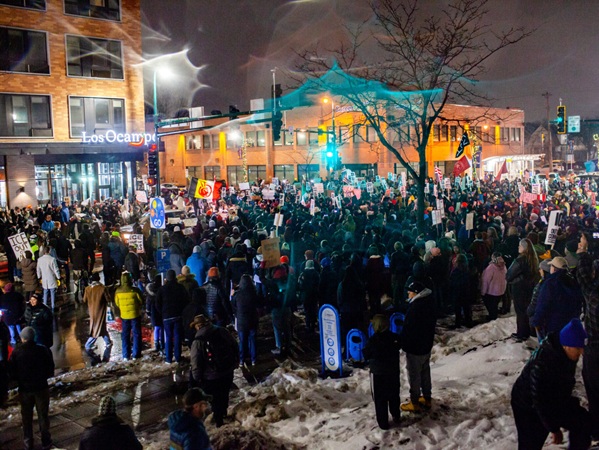
However, in Minneapolis, the Trump regime has also been confronted by a powerful movement that points the way toward defeating its entire agenda. Tens of thousands have participated in mass protests and also organised in their communities to bring food and other essentials to those in hiding, to monitor and record ICE activity, and to alert people to their presence. The day before the murder of Alex Pretti, up to 100,000 protested in Minneapolis in what was widely described as a general strike, with large numbers of workers staying out of their homes and shutting down sections of the economy. This was complemented by many small businesses shutting for the day as well. This powerful movement has demonstrated both the power of solidarity and the power of working-class people, on whom the economy and the wealth of the capitalist class depend.
This movement of solidarity has also refuted the idea that the only way to push back the electoral support for the far-right is to concede to their ideas. This idea has been widely pushed since Trump was elected within the Democratic Party, the media and other sections of the establishment, particularly that Democrats must move (even) further to the right on migration. This was justified by polling, which showed that public opinion had favoured Trump’s call for a harder line stance. In fact, accepting anti-migrant frameworks has only strengthened the hand of the right.
However, since his election, the pendulum has swung in the other direction. Now, for the first time, more support the idea of abolishing ICE than oppose it, while bigger majorities now oppose the ICE crackdown and Trump’s approach to migration. This is a product both of the revulsion people feel seeing ICE’s tactics, but also because of the impact that movements of struggle and solidarity can have on social attitudes.
Trump on the back foot
The Trump administration now seems indecisive on how to proceed in Minneapolis and on the anti-migrant offensive generally, with different factions pushing either for a partial climbdown or ‘staying the course’. This has been reflected in Trump’s removal of the head of ICE’s operation in Minneapolis, Greg Bovino, but so far, speculation that ICE would be removed from the city has not materialised. An escalation of the struggle, including strike action, could potentially force this and deal a much-needed blow to the far-right regime. Trade unions, which organise in key cities affected by the ICE raids, must mobilise workers in generalised industrial action against both Trump’s actions and companies such as Starbucks that facilitate them.
In contrast to the courage and militancy of the Minneapolis protestors stands the Democratic Party establishment. While a cohort of ‘moderate’ Democrats voted to fund the Department of Homeland Security (of which ICE is a subagency) just over a week ago, the Democratic leadership has decided to limit itself to demanding minor reforms to ICE’s practices in exchange for cooperating on funding. While their approach squanders an opportunity to press the weakness of Trump on this issue, it also flows from their attachment to parliamentary dealmaking, their hostility to the politics of struggle and mass organisation and also their own attachment to a ‘reformed’ version of the US government’s repressive apparatus. Fundamentally, they are opposed to a working-class struggle from below against this racist system of US capitalism.
But the experience of Minneapolis shows the possibility of building something completely different. We need a movement of the working class and the oppressed from below, which:
- Stands in unapologetic solidarity with migrants, whether documented or undocumented, and with people of colour and all oppressed groups
- Opposes all deportations and fights for the abolition of ICE, the arrest and prosecution of its murderous agents and legal status for all undocumented migrants.
- Organises ordinary people on a mass basis in workplaces, communities, schools and colleges
- Is based on the power of the working class people when organised to shut down the economy and disrupt the plans of the wealthy and powerful
- Builds a united movement against all aspects of the Trump regime’s far-right authoritarian agenda, including attacks on LGBTQ+ people and women’s rights, imperialist war and genocide abroad and attacks on workers’ living standards at home.
- Opposes and fights the US imperialist and capitalist system, which is at the root of the Trump regime and of racism and state repression. There needs to be a break with the two main parties that uphold this system’s rule.