
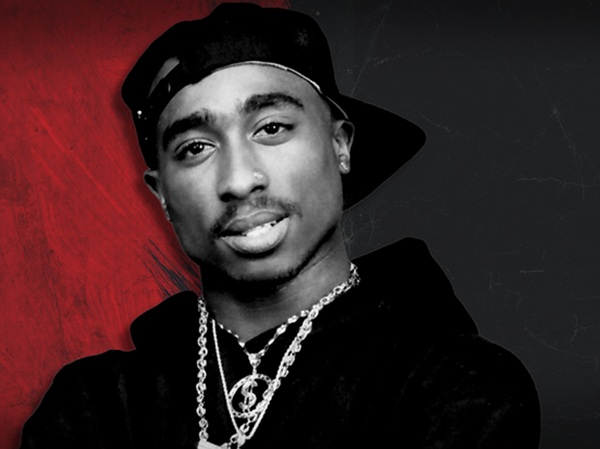
It’s hard to name a rapper who has had more of an influence on popular culture than Tupac Shakur. There have been more than 40 works written about him, and he’s sold 125 million records. It’s impossible to document how many times other rappers have name-dropped him or included his lyrics in their songs, but it runs into the thousands. Twenty-nine years after he was killed at the too-soon age of 25, a new book about him by a Dublin author is reviewed here.
Tupac Shakur’s circumstances provided him with a very unique experience of the world. This gave a certain depth to his music, poetry, and acting that at times indicated a maturity beyond his years. His 1995 song “Dear Mama” documented his experiences of childhood poverty and his love for his mother, Afeni, who struggled with an addiction to crack cocaine. Like much of his work, the vulnerability and empathy at the heart of the song have continued to resonate with millions of listeners.
However, “Dear Mama” doesn’t give the full picture. Like many other lone parents, Afeni struggled to raise children and pay the rent, and Tupac wanted to document the courage of those parents. What was left out of the song was Afeni’s incredible backstory of revolutionary struggle. A member of the Black Panther Party, Afeni was arrested in 1969 along with 20 of her comrades on trumped-up charges of conspiracy to bomb police stations and other public places in New York City. While she was pregnant and facing 156 felony charges, she represented herself in court, where she questioned witnesses, many of whom were cops or infiltrators. Despite having no previous legal experience or qualifications, she successfully defended herself and the other defendants in an eight-month trial.
In June 1971, one month after the acquittal, she gave birth to Lesane Parish Crooks, who was later renamed Tupac Amaru Shakur. She named him after an 18th-century indigenous Peruvian leader, Tupac Amaru II, who led an uprising against Spanish colonisers. In her words, “I wanted him to know he was part of a world culture and not just from a neighbourhood… I wanted him to have the name of revolutionary, indigenous people of the world.”
Black Power roots
To this day, most portrayals of Tupac in the mainstream media superficially depict him as a reckless, antisocial tearaway, but anyone with more than a superficial familiarity with his music will know that his outlook was steeped in social awareness and political analysis. And how could it have been any other way, given that Afeni raised him in such a political environment? His godfather was Geronimo Pratt, a leader of the Black Panthers, while his godmother was Assata Shakur of the Black Liberation Army.
After the publication of dozens of biographies and documentaries about Tupac, Dubliner Dean Van Nguyen has published a book that finally shines a light squarely on the politics of the hip-hop icon. Van Nguyen is a writer specialising in music criticism, and his critiques of Tupac’s music, album by album, will appeal to fans of the rap star. In a 1992 interview, Tupac explained, “My music is about the oppressed rising up against the oppressor. The only people that’s scared are the oppressors. The only people having any harm coming to them are those who oppress.”
The message
Van Nguyen documents how Tupac’s left-wing political roots shone through in his songs, from the explicitly anti-capitalist “Panther Power” to the pro-choice and feminist messages in “Keep Ya Head Up” and “The Good Die Young”. He rose to prominence at a time when hip-hop was entering the mainstream and coming under increased corporate dominance. While the early days of hip-hop were dominated by either “party rap” or the socially conscious sounds of groups like Public Enemy or Grand Master Flash and the Furious Five, the 1990s were dominated by music about drug-dealing and violence, with a heavy dose of misogyny thrown in. Van Nguyen outlines this process and how Tupac’s message and style changed over time, especially with the release of the album All Eyez On Me after he joined Death Row Records in the final year of his life.
Death Row Records had brought West Coast “gangsta rap” to a worldwide audience, and its artists were noted for their particularly sexist lyrics. Tupac was not free of this, and some of his material is deeply misogynistic. Some of the tracks on the 1996 All Eyez On Me are steeped in sexism, and his song “Hit ‘Em Up”, attacking fellow rapper Biggie Smalls, sank into petty, personalised and bullying territory, beyond the battle-rap norms of hip hop at the time. By contrast, his earlier work was more socially conscious and dealt with themes such as child sex abuse that don’t often feature in hip hop or any other musical genres. “Brenda’s Got a Baby” features the story of a child who becomes pregnant after being raped by her cousin. The less well-known posthumous song, “16 on Deathrow”, features powerful lyrics narrated from the viewpoint of an imprisoned sixteen-year-old boy:
“Dear mama, these cops don’t understand me
I turned to a life of crime, cause I came from a broken family
My uncle used to touch me. I never told you that
Scared what you might do, I couldn’t hold you back
I kept it deep inside and let it fuel my anger
I’m down for all my homies, no mercy for a stranger
The brother in my cell is 16 as well
It’s hard to adapt when you’re black and you’re trapped in the livin’ hell…
They tell me the preacher’s there for me
He’s a crook with a book, that MF never cared for me
He’s only here to be sure
I don’t drop a dime to God about the crimes he’s committin’ on the poor
And how can these people judge me?
They ain’t my peers and in all these years they ain’t never loved me
I never got to be a man
Must be part of some big plan to keep a n***a in the state pen”
His lyrics might often seem overly direct and heavy-handed, lacking the vagueness, evasiveness, arcane double-meanings and clever turns of phrase found in the works of Joni Mitchell, Bob Dylan or Grian Chatten. However, the delivery, sound and raw lyrics combine to have a powerful impact on the listener. Tupac mentioned his intentions behind the song “Dear Mama” in a 1995 interview with the Los Angeles Times:
“I’m the kind of guy who is moved by a song like Don MacLean’s ‘Vincent’, that one about Van Gogh. The lyric on that song is so touching. That’s how I want my songs to feel. Take ‘Dear Mama’ – I aimed that one straight for my homies’ heartstrings.”
He may not have been the most sophisticated lyricist in rap history, and he wasn’t even the most political rap artist either, but when it came to affecting the emotions of the listener, he excelled.
Education against all odds
Van Nguyen notes how Afeni began to cultivate her son’s cultural level early on in his childhood in Harlem. She would sometimes make him read the entirety of a copy of The New York Times as punishment for misbehaving. At age 13, he performed in the play A Raisin in the Sun at the Apollo Theatre. He trained in ballet at the Baltimore School of the Arts as a teenager and performed the role of Othello in a school production of the Shakespeare play.
His outlook was clearly also broadened by his mother’s years of revolutionary activity. Van Nguyen charts the background to the radicalisation of Afeni, with extensive, if sometimes tangential, descriptions of the political lives of Malcolm X, Bobby Seale and Huey Newton. The first 100 pages of Van Nguyen’s book barely feature Tupac, while later chapters give in-depth accounts of the 1992 LA riots and gang feuds in South Central LA.
Afeni’s descent into the abyss of crack addiction no doubt coincided with her weariness over the collapse of the movement she helped build. The hopes she and her comrades had for real revolutionary societal change were dashed, as the social movements and workers’ struggles of the 1960s and 1970s receded. The crack epidemic in American cities coincided with a dramatic rise in wealth inequality. The establishment used the racist myth of “welfare queens” to attack basic public services. In his first State of the Union address in 1992, Bill Clinton planned to further impoverish the most disadvantaged Americans by promising to “End welfare as we know it… We have to end welfare as a way of life.” In the song “Letter to the President” Tupac asks Bill Clinton,
“Sayin’ you cuttin’ welfare
That got us ns on the street think’ who in the hell care?
What happened to our 40 acres and a mule, fool? …
Tryna turn us young ns into troops
You want us to fight your war, what the f*ck I’m fightin’ for?
The so-called “end of history”
Added to this, pro-capitalist liberals and conservatives waged a historic campaign of right-wing triumphalism after the collapse of the Soviet Union, and the idea took hold in society that there was no alternative to the status quo of racism and oppression. The phrase “I’m hopeless” appears repeatedly in Tupac’s songs, underscoring the importance of the early 1990s geopolitical context for understanding the mindset of far-left radicals like the Shakurs at that time.
Tupac briefly joined the Baltimore chapter of the Young Communist League and later served as the chairperson of the New Afrikan Panther Party. Both organisations were largely unknown to the wider black community, so they had no real support base.
While his forays into organised politics were short-lived, his music contained a political thread to a much greater extent than other artists of his stature at the time. The words “They got money for war, but can’t feed the poor” from “Keep Ya Head Up” resonate even more today than when they were written. So, it was no surprise to Tupac fans when the song “Changes” became the soundtrack to the mass protests against racial oppression and police brutality after George Floyd was murdered by a cop in Minneapolis in 2020.
“Success only adds on to the stress”
During his lifetime, the media focused on Tupac’s run-ins with the law. In 1991, he filed a lawsuit against two Oakland Police Department officers who assaulted him after they stopped him for jaywalking. The officers choked him and slammed him to the ground, with his head hitting the concrete. This traumatic incident is often cited as the origin of the alopecia he developed at the time. A year later, he faced trial and was acquitted for shooting two white off-duty cops in Atlanta, whom he had witnessed attacking a black man. The following year, he sustained five bullet wounds during an attack by a group of men in New York. Every account of Tupac’s life describes how his personality seemed to have changed in the last years of his life. Van Nguyen describes how he spent a lot of time with organised crime figures such as Jacques Agnant (Also known as “Haitian Jack”) and Jimmy “Henchman” Rosemund when preparing to play the role of a drug dealer in the film, Above the Rim.
His artistic persona definitely became more hypermasculine around this period, which suited his move to Death Row Records in late 1995. One year later, he attended a Mike Tyson fight at the MGM Grand hotel in Las Vegas with Suge Knight, the owner of Death Row. Knight was affiliated with the Mob Piru Blood gang in Los Angeles and used his gang connections for security and business dealings. After the Tyson fight, one of Knight’s Blood associates spotted a member of a rival gang and pointed him out to Tupac. Surveillance footage showed Tupac approaching the rival gang member in the lobby of the hotel and punching him in the face as his associates joined in to assault the man after he fell to the ground. A few hours later, Tupac was shot while sitting in the passenger seat of Suge Knight’s car as they waited in traffic on Las Vegas Boulevard. He passed away in the hospital six days later.
In the years before his death his songs were filled with the words “misery”, “memories”, and “Hennessy”. His childhood friend, Jada Pinkett Smith said “People don’t like to talk about [the fact that] Pac was an addict… high all the time, drunk, whatever, his mind was never clear.”
The lyrics of “Lord Knows”, while seemingly from the perspective of a fictional narrator, give a sense of Tupac’s focus on mental health, paranoia, trauma and addiction,
“My memories bring me misery
And life is hard, in the ghetto it’s insanity
I can’t breathe…
I smoke a blunt to take the pain out
And if I wasn’t high I’d probably try to blow my brains out,
I’m hopeless, they should’ve killed me as a baby,
And now they got me trapped in the storm, I’m going crazy,
Forgive me.”
What could have been?
Before his death, Tupac had been recording music in a frenzy to fulfil his contractual obligations with Death Row Records. Van Nguyen explains how he had even begun to plan the launch of his own media company called Euthanasia Incorporated, where he expressed that he would oversee screenwriting projects and youth outreach programmes. One can only speculate whether he could have grown out of the hypermasculine persona that had led him to engage in the LA gang feuding culture that he hadn’t grown up in. His actions at the MGM Grand on the night he was shot were far removed from the young poet who had made his mark at the Baltimore School of the Arts.
It’s also worth emphasising that the hypermasculine persona was driven by Tupac’s ambition for success. There was an expansion of the so-called “gangsta rap” genre of hip hop in the early nineties, whose subject matter was often about guns, selling crack, evading the police, and feuding with rivals. One end of the spectrum tended towards a sociological documenting of the streets, and the other end tended towards first-person narratives that revelled in gender-based violence and celebrating drug money and expensive jewellery. Defenders of this genre of hip hop argued that this music was only a reflection of behaviours and culture that existed in very socially and economically disadvantaged communities, marred by exploitation and racial oppression. That the artists weren’t personally responsible for creating the social conditions that produced the anti-social behaviours and attitudes that were depicted in the music.
It is also worth emphasising that corporate America profited enormously from the work of black artists, at the expense of those artists. The music industry was dominated by white corporate CEOs who were quite comfortable with projecting very narrow depictions of black men, which sometimes verged on caricatures and stereotypes. Not to mention white corporate America’s hypersexualisation of black women, who appeared much more often as background music video models rather than as artists in 1990s hip hop.
As Tupac’s music and image became more macho and less political, his profile grew from strength to strength. Simply put, the success of the hypermasculine persona fed the transformation.
“I ain’t sayin’ I’m innocent in all this”
To Van Nguyen’s credit, unlike many of the biographies and documentaries about Tupac Shakur, he doesn’t sugarcoat the facts that led to his 1994 conviction for sexual assault. In fact, Van Nguyen gives multiple quotes from an interview with the victim, Ayanna Jackson, in 2018. Ayanna outlined how the consensual sex she had with Tupac in the days before the incident was used against her in court to try to discredit her. She accuses Tupac, “Haitian” Jack, and another man of raping her in a hotel room, and her description of what happened was corroborated by another witness who was in the hotel room that night – Tupac’s road manager at the time, Charles Fuller. Van Nguyen quotes Tupac’s defence lawyer, who disgracefully leaned into sexist victim-blaming, stating, “It is our position that this woman is highly incredible… what we have here is a woman who was infatuated with Mr Shakur. Don’t be fooled by emotions displayed on the witness stand.”
Ayanna revealed that Tupac apologised to her in court before his sentencing, but unfortunately, he continued to proclaim his innocence in public, as did his family and friends. He went on to serve ten months in prison. Van Nguyen observes that in the song “White Manz World”, released after his death, “a more contrite 2Pac apologises to the black women whose pain he has overlooked – no specifics”.
“Through every dark night, there’s a bright day after that”
Overall, Van Nguyen succeeds in recognising Tupac’s enormous influence on hip hop, popular culture, and art over the past 35 years without idolising him. The book starts with the observation that Tupac’s face appears on murals across the world as often as images of Che Guevara and Bob Marley. When learning about the incredible life story of him and his mother, it’s easy to fall into romantic sentimentalism, but Van Nguyen gives enough concrete information to show that, despite their exceptional talents, the Shakurs were traumatised and struggling to survive like the rest of us. They were also marked by many mistakes, transgressions and contradictions.
There is no doubt that the pain and roadblocks they encountered spurred Afeni’s political brilliance and Tupac’s deeply affecting music, and both were typified by an enduring sense of optimism that a better world is possible. Reagan’s counter-revolution was the backdrop to Tupac’s formative years, and history is now repeating itself under Trump’s reactionary administration. It is therefore very fitting that Van Nguyen ends the book with a quote from the Makaveli album: “The trick is to never lose hope”.