
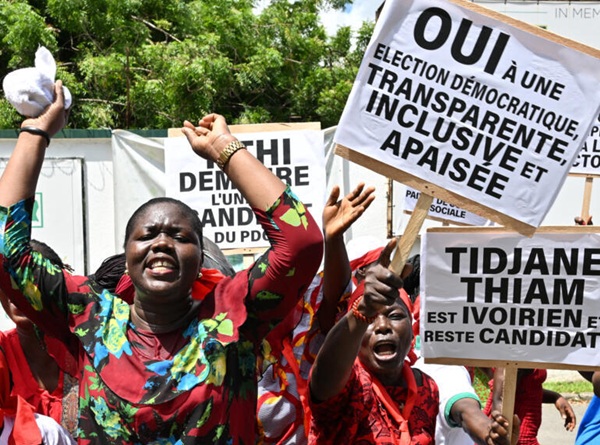
The Ivorian presidential election officially took place on October 25. At the time of writing—at the request of the government—the entire political class, except for Gbagbo’s PPA-CI (Parti des peuples africains – Côte d’Ivoire) and Guillaume Soro’s GPS (Générations et Peuples Solidaires), is preparing to take part in the legislative elections scheduled for December 27. What must be emphasised above all is the climate of terror that preceded this election and continues to this day.
We had already said in a previous article that the Ouattara government had everything to gain by sidelining its potential opponents —Gbagbo, Thiam, and Soro— and by creating a climate of insecurity to prevent the population from expressing itself freely. While it is clear that the opposition’s strategy focused too narrowly on the unconstitutionality of Ouattara’s fourth term, it is also necessary to show the myriad ways in which the people’s voice was silenced.
To lay out the facts, we must begin with the exclusion of Ouattara’s main challengers from the race. Then we must speak of the massive security apparatus: 44,000 security forces supported by hundreds of armed militiamen deployed to intimidate and massacre. Even though the government tries in vain to downplay these events as isolated incidents or inter-communal clashes, multiple testimonies collected from local populations confirm that these were indeed planned actions carried out under the supervision of officials. The human toll of these massacres is 30 dead and more than 2,000 protesters arrested, with hundreds of arbitrary sentences handed down through exceptional procedures.
Another important element is the extremely low participation rates. The real voter turnout is 18%, even though the government insists on inflating it to 30%. In Cocody —a suburb, home to a large portion of the middle class in Abidjan —the turnout was 19%. Same story in Abobo —supposed stronghold of the regime— with only 40% participation. In response to this weak turnout, the government launched a massive operation to evict residents in the Abobo district the day after the election!
The election took place under intense security pressure. Out of embarrassment, the government was forced to cancel several ceremonies celebrating Mr. Ouattara’s inglorious “victory.” A rally planned for this purpose in Séguéla, one of the most important northern regions, was cancelled by the authorities.
Results known in advance
It should be added that on the eve of the election, Friday evening, October 24, an online media outlet that has worked with the electoral commission for several years on announcing results leaked the presidential results, naturally declaring Ouattara the winner. The statements issued by the electoral commission and by the media outlet failed to convince the public to believe that the election had not been pre-determined. Yet an implausible 90% landslide was awarded to Ouattara.
Deserted polling stations
This was an electoral hold-up committed against popular sovereignty. The people did not go out to vote. They boycotted. The example of Abobo —stronghold of the RHDP— is a perfect illustration. In Cocody as well —a municipality that houses much of the petty bourgeoisie and elite— the turnout was abysmal. This lack of mobilisation revealed the scale of popular rejection and disaffection.
The use of militias: proof that the population is no longer willing to fight for this regime
Given that this regime built its political base on ethnicity —Malinké— and religion —Islam— and is today forced to rely on militias, it is clear that its identity-based discourse has reached its limits. In the areas where armed attacks against civilians took place, they occurred without intervention from local civilian populations or the army. Even in the Nahio case, which caused widespread shock, the houses burned were selected —even though all were in indigenous neighbourhoods— and several testimonies report that the attackers were masked and equipped with war weapons. In past inter-communal conflicts, one of the communities always fled the village. But in recent events, none of this happened. All supposedly opposing communities are still present. Even if some testimonies suggest that certain local residents acted as informants, nothing indicates their direct involvement in the attacks.
The international community’s late congratulations
The international community —led by France, the former colonial power— usually quick to congratulate “its presidents,” took time before reacting. They gave the impression of waiting for the official results, but in reality it was the entire situation —with its string of lies and manipulations— that delayed official reactions.
Intensify the struggle to transform anger into popular mobilisation
Through their massive abstention, the Ivorian workers and popular masses refused to endorse this fraud. They demonstrated their absolute attachment to their own interests. They showed that they are no longer willing to die for leaders who think only of themselves. As for the political opposition, it revealed its incapacity to lead a struggle that goes beyond institutional demands. It failed to build mobilisation around more compelling demands. We must commit ourselves to occupying this terrain now.