
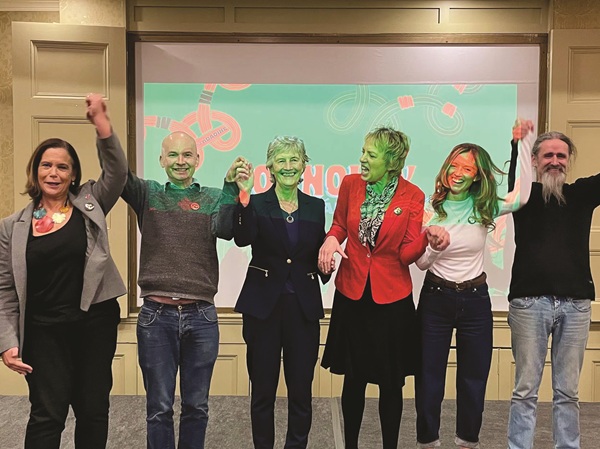
In a world of demagogic “strongman” leaders like Trump, Putin and Netanyahu, and spineless ones like Keir Starmer or Micháel Martin, having a left-wing President like Catherine Connolly is something to be thankful for. Indeed, many people around the world celebrated Connolly’s victory, and now look to Ireland as a place where the left can possibly make a breakthrough, bucking the trend of right-wing advances elsewhere.
Here too, in the wake of the presidential election, there has been increasing commentary about the potential for cooperation among the opposition parties to cohere into an alternative government at the next general election. Given the makeup of the current government, of Fianna Fáil (FF), Fine Gael (FG) and a batch of ‘regional’ right-populist independents, the division in the Dáil is seen broadly as one between right and left.
This is, after all, one of the most right-wing governments in the history of the state, and all the elements that make up the government are on a trajectory of moving further right, in line with international trends, but also under pressure from the small but vociferous forces of the far right in Ireland. This is seen in the cynical and disgraceful rhetoric about immigration, and the stunts like Justice Minister Jim O’Callaghan’s deportation charter flights.
For good reason, then, more and more people want to get rid of this government – and after 100 years of continuous rule, both FF and FG.
The opposition
Getting rid of FF and FG is a real possibility. These parties have been on a clear decline for decades, and the presidential election showed how weak their bases have become, particularly among young people. The only question is what can replace them, and the most obvious answer right now is an alternative government led by Sinn Féin, supported by Labour, Social Democrats, and others.
Such an alternative government would be, given the policies these parties currently espouse, a relatively progressive alternative to the traditional right-wing establishment parties. This would no doubt be welcomed by most people. As such, Solidarity TDs, if elected, would vote to allow such a government to be formed, while remaining in opposition and holding it to account on whatever progressive promises it makes.
But more than this, we will hold them to account in the years leading up to an election. There are, to be sure, many issues on which we can agree with other political forces, and can cooperate in campaigns and movements, inside and outside of the Dáil and council chambers. On issues such as climate change, military neutrality, animal rights, gender-based violence, housing and cost of living, we have voted and even marched alongside other opposition parties.
Yet, even in opposition, parties such as Sinn Féin, Labour and the Soc Dems have exposed their evident shortcomings as political alternatives. Whether through Labour’s disgraceful vote on Dublin City Council to hike rents for council tenants; the Soc Dems’ welcoming back Eoin Hayes TD despite his shameful profiting from shares in Palantir; to Sinn Féin’s deplorable caving to racist sentiments on immigration, or backward attitudes on fox hunting, or transphobic notions about puberty blockers – the list goes on – these parties having proven to be less than trustworthy as champions of left or even progressive principles.
They also, as it happens, refuse to rule out entering coalition with FF and FG.
A genuinely left government
Writing about the potential ‘left alliance’ on 10 January, Irish Times political editor Pat Leahy made the point that:
“A delicate question is posed by the role of People Before Profit-Solidarity… none of their putative partners believe for a moment that any imaginable programme for government would be sufficiently left-wing for People Before Profit-Solidarity to support. In other words, nobody expects People Before Profit-Solidarity to be in government with them. That being so, a break is inevitable – and better to have it sooner rather than later and before the left-wing alliance has been dragged too far to the left, the argument goes.”
No doubt this is an accurate description of the views in other parties. For our part, in Solidarity, we will continue to argue for what we think is needed – whether investment in free and expanded public transport and childcare, green energy infrastructure, an €18 minimum wage, the banning of foreign militaries from our airports and airspace, rent reductions and freezes at affordable levels, a one-tier national health service, a not-for profit state construction company to build the homes, schools and medical centres we need, and to retrofit the existing ones etc. etc. We’ll let those other parties explain which policies are too ‘left-wing’, but we think these and others like them are essential.
This is why we want to see a genuinely left government – one based on a mass anti-capitalist and socialist movement in society, that fights for democratic public ownership of the key wealth and resources of society, and a radical transformation of the economy to meet people’s needs. It isn’t a question of left-wing ‘purity’, but what’s practically necessary. Because that’s the only kind of government that can possibly deal with the multiple chronic crises we face, all of which are only going to become more acute as the capitalist world continues to devour itself in the coming years.
Any government that supports an economic model dominated by multinational corporations will be a government that’s beholden to those corporations – and the imperialist powers that back them. That government will inevitably put corporate interests over public and environmental interests, which is in fact the root of the problem with FF and FG. Unfortunately, Sinn Féin, Labour and the Soc Dems support such a model. This is a problem we have to talk about, and it can’t wait until after the next election.