Months of piracy in the Caribbean, which saw US forces sink 20 small Venezuelan vessels, and the resulting murder of scores of crew, as well as the pursuit and seizure of oil tankers, proved over the last 48 hours to be a mere prelude to a criminal attempt by the Trump regime to achieve regime change.
Far from a ‘surgical strike’, bombs were dropped on targets including a civilian port and airport, with reported deaths totalling 40 at the time of writing. The New York Times reports that the $50 million reward put on the head of Maduro contributed to elements from within Maduro’s administration sharing intelligence with the CIA on his movements, facilitating his and his wife’s kidnapping. We oppose this colonial attack and demand the immediate release of Maduro and Cilia Flores.
Imperialist lies
The accusation that Maduro has been responsible for the export of drugs into the US is a flimsy smokescreen that does not deserve an ounce of credence. Venezuela is by no stretch of the imagination a significant player in the manufacture and distribution of fentanyl, no more than Canada, which earlier in the year was at the receiving end of similar accusations as a prelude to the imposition of tariffs. Contrast this to Trump’s recent pardoning and release from prison of former Honduran President Juan Orlando Hernandez, someone who directly profited from the drug trade.
For the truth behind US imperialism’s motives, one need look no further than the publication last month of its National Security Strategy, which called for the revival of the Monroe Doctrine and the prevention of rivals, China in particular, from acquiring and deepening their economic interests in the hemisphere. The Monroe Doctrine harks back to the 1823 declaration by the then US President that effectively reserved the right of the US and the US only, to subordinate the whole of Latin America and the Caribbean to US interests.
For most of the period following World War Two, the public emphasis of successive US administrations was that a rules-based international order would govern international relations through organisations such as the United Nations, the World Bank, the International Monetary Fund, and the World Trade Organisation. Of course, this was a fiction. Military force and undemocratic coups were not eschewed from Vietnam to Chile when the US saw direct threats to its interests. However, even with the criminal invasion of Iraq in 2003, we had the charade of the Bush administration making its case to the UN first before the invasion.
US imperialism’s backyard
The recently published National Security Strategy explicitly seeks to break with any pretence of a multilateral approach in favour of an unvarnished assertion that US imperialist might is right. The bombings in Nigeria and previously in Iran and the persistent claims being made on Greenland, have to be seen in this light. The ‘rules-based’ world order is out, and the wild west is in.
US economic sanctions on Venezuela can be traced back to the Obama administration and were further ramped up under Trump’s first administration. From 2014 to the COVID pandemic, Venezuela’s GDP decreased by 75%. Wages have been suppressed and public services, greatly expanded in the time of Hugo Chavez, are a shadow. The population of the country has declined from 28 million to 20 million mainly through mass migration to other South American countries.
In the context of this economic siege of Venezuela, like much of Latin America, it developed links with China. The Chinese state-owned oil company established its first oil platform in Venezuela last September. China has extended over €50 billion in loans to Venezuela, and the latter has been buying its arms from China. The US intervention into Venezuela seeks to disrupt the Chinese State interest here and throughout Latin America and in the case of Venezuela, position US oil companies to benefit from the estimated 300 billion barrels of untapped crude oil, some 20% of the world’s reserves.
The $50 million bounty
The Democratic Party’s opposition in the US and European leaders, including the Taoiseach, insofar as they have offered any overt or implicit criticisms of Trump, have confined themselves to procedural shortcuts, with no reference to the US House of Representatives or the UN.
Given the lines of communication between elements of the Maduro regime and the CIA, it is not yet determined that Maria Corina Machado, the opposition figure latterly backed by the West, can be installed. Forcing a total clear-out of the Maduro administration in the absence of a domestic alternative capable of stepping in means that achieving this end would require a scale of on-the-ground US military presence, which would provoke opposition in the US, including from within the MAGA camp. Early indications are that the Trump regime will first try to strong-arm the existing administration into agreeing to the changes they want, in particular, US access to the oil reserves, to the detriment of its main global rival, Chinese imperialism.
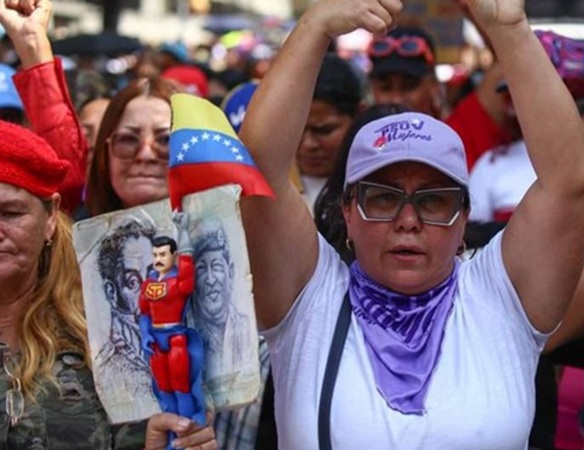
The left opposition within Venezuela accurately describes the Maduro regime as corrupt and authoritarian. He has none of the attributes of his predecessor, Hugo Chavez, who, despite never decisively challenging and breaking with capitalism in Venezuela, was credited with a period of sustained redistributionist policies that materially improved the lives of the working class, poor and indigenous peoples. These popular reforms explain the decisive mobilisation of the Venezuelan masses against the failed 2002 coup attempt and the bosses’ 2003 lockout.
The Maduro government
However, it does not follow from this analysis of Maduro that any measure of support can be given to US imperialist aggression or the right-wing opposition within the country. Should the old elite retake power for the first time since Chavez’s election in 1999 and go on to faithfully serve US oil interests, it would usher in an even worse period of poverty, racism and repression.
The working class in Venezuela and Latin America must independently organise and actively oppose US imperialist aggression on the ground and appeal for support from working-class people internationally, including working-class people in the US. The international movement of solidarity for Palestine provides an enduring example of the sentiment that can be tapped into, including mass mobilisations on the streets and possible industrial action, like the two general strikes we saw in Italy in October last year.
Centuries of colonial conquest and imperialist domination have brought nothing but misery to the masses of Latin America. Trump’s new colonial adventure in Venezuela is another chapter in this horrendous history—the working class, the poor and oppressed must build a continent-wide revolutionary movement that breaks the stranglehold of imperialist and capitalist domination and exploitation. There can be no half revolutions; the whole system must go. This is the bitter lesson of numerous struggles for socialist change in this region.