
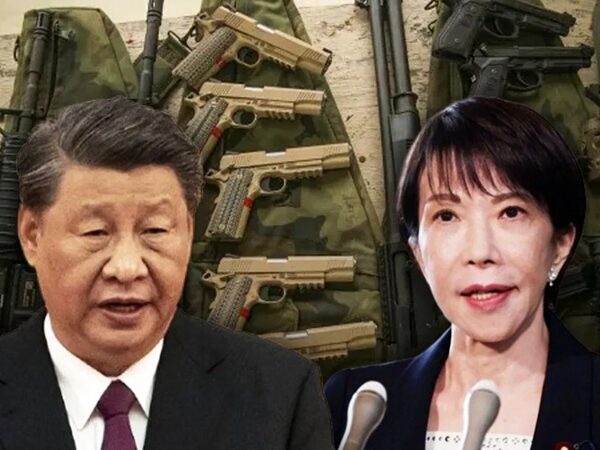
This time it was the sabre-rattling by Japanese leaders that provoked new tensions with China. In early November. Newly elected Prime Minister Sanae Takaichi told the Diet [Japanese parliament] that if China sent warships and used force against Taiwan, this would cause an “existential crisis” for Japan and lead to the use of force by Japan. China’s defence ministry replied angrily that she was harboring ambitions to “remilitarise” Japan.
Japan’s elite moves to the right
Takaichi, who promotes herself as a Japanese Margaret Thatcher and echoes a Japanese version of MAGA, has consistently argued for amendments to the country’s constitution to allow the use of force to settle international disputes and for getting more involved in Taiwan’s fate.
Takaichi’s election as leader of the Liberal Democratic Party (LDP) follows the historic defeat of the LDP in the election of July 2025, which has held power almost continuously, except for two short periods (1993-6 and 2009-12) since its formation in 1955. In July it lost a majority in both houses of the parliament.
The big gainer in that election was the far-right Sanseito party, which won nearly 16% of the constituency and 13% of the national vote, increasing its seats from one to fifteen. The LDP remains in power only by forming an alliance with another right-populist party – Ishin (Japan Innovation Party). The coalition agreement starts by stating: “In order to overcome the most severe and complex international security environment since World War II, we must promote domestic and foreign policies that will strengthen and enrich the Japan archipelago and advance it as a proud “self-reliant nation.”
This significant shift to the right reflects a growing disillusionment in the more centrist approach of Takaichi’s predecessors, as well as a strengthening of nationalist sentiments in response to China’s growing military presence.
At the same time, her statements are used by Chinese hardliners to increase their anti-Japanese rhetoric. Xue Jian, China’s consul-general in Osaka, who has a reputation as a “wolf-warrior” posted on X that he would “‘cut her dirty neck without a moment of hesitation” [machine translation]. This naturally deepened the diplomatic crisis between the two countries. At the end of December China conducted major military exercises around Taiwan.
Trump’s National Security Strategy
Taiwan is at the centre of the crisis. There is a simplistic analysis of Trump’s recently published “National Security Strategy” (NSS) that suggests he is acting like a CEO in a struggling corporation, who is trying to cut-back loss making units and unnecessary expenditure. A recent article in the South China Morning Post for example says the NSS : “marks a sharp geographic and political turn. It moves the western hemisphere to the top of the agenda and pushes Asia – and with it, visible China-centric “great power competition” – down a notch.” This, though, for the Chinese regime is wishful thinking.
The NSS clearly ditches Biden’s false claims to support Taiwan to oppose coercion, promote democracy and defend a ‘rules-based’ global system. Now the brutal reality of MAGA driven US imperialist interests are outlined. Taiwan is important, the NSS says, because of its dominance of the semiconductor market, and because of its strategic position in the South China Sea, through which a third of global shipping including between the US and key partners such as Japan and South Korea passes. As the Singaporean analyst Yaqi Li comments: “NSS does not need Taiwan to be morally exceptional; it needs Taiwan to be materially indispensable.”
Flowing from this, the NSS drops Biden’s “opposition” to any unilateral attempt to change the status of Taiwan by either side. Biden explicitly stated that the US does not support “Taiwan independence” and remained committed to the “one China policy”, supporting “Taiwan’s self-defense”.
Instead the NSS says it will maintain, what it describes as a “declaratory policy”, not to support any unilateral change to the status quo in the Taiwan Strait. But it drops the promise to support Taiwan’s “self-defence”, but will “deter conflict” over Taiwan by prioritising “military overstretch”. As with the US’s conflict with Europe, now Taiwan and the other countries in this region will be expected to increase their military expenditures primarily in defence of US trade interests, and the countries themselves will have to foot the bill.
In line with this Taiwanese President Lai Ching-te at the end of November warned that China is stepping up its plans to invade Taiwan, and that therefore the country should make no compromises as far as military defence is concerned. He announced a further $8 billion increase in military expenditure, which is due to consume 5% of GDP by 2030. A key element of the increased expenditure is the recent announcement by Trump to allow the sale of a $11billion package of US produced weapons.
Trump pressurises Japan
When the global economic crisis hit in 2008, Japan was still the second largest economy in the world. It had grown during the post-war decades to such an extent that it was often said that it would soon overtake the US economy. But by the end of the 1980s excessive bank lending and economic stagnation led to the expansion of the rift between the real value of assets and their market prices – a huge speculative bubble that burst in 1989, leading to an immediate collapse of stock market values by 45%. What followed was nearly three decades of stagnation and deflation, which despite repeated attempts by the government to stimulate the economy out of crisis only led to a massive increase in debt. In 2025 nominal GDP was $4.28 trillion, lower than 1995’s $5.55 trillion. GDP per capita fell from $44210 to $34713 in the same period. The gross debt to GDP ratio grew from 92% in 1995 to nearly 300% in 2025.
Trumpism, particularly its second iteration, has caused serious instability in the Japan-US alliance, under which the US was seen as the main economic and security partner of Japan. The immediate imposition of 24% tariffs on Japan was later negotiated down to 15%, but on the understanding that Japan would increase its own arms expenditure and, in effect, rescind its neutrality status and agree to invest $550 billion in US projects.
Rice, Japan’s stable food, became a point of disagreement in the tariff negotiations. The government for decades protected the domestic rice industry through high tariffs on imports and by maintaining a reserve to be released if shortages developed. This year though, a combination of poor harvests caused by record temperatures, corruption and mismanagement of the scheme resulted in shortages and high prices, and even in places protests. Trump used this situation to leverage the government to allow the import of US rice.
In 2022 Japan published its own new Security Strategy due, it said, to an environment more ‘severe and complex’ than at any other time in the post-Second World War period. On the one hand, it was seeing increasing cooperation between China, North Korea and Russia as well as the global shock caused by the Russian imperialist invasion of Ukraine. Formally no peace treaty between Japan and USSR/Russia has even been ratified after WW2 partly because both sides claim control of the Kuril Islands. According to the new strategy, Japan will double its arms expenditure, and develop a missile counter-strike capacity.
This new strategy, though, was developed in a different geo-political environment. As late as August 2023 the dominant feature was the strengthening of security and defence agreements in the regime, highlighted by Joe Biden’s “Camp David Principles” in which Japan and South Korea committed themselves to support defence pacts including QUAD and AUKUS.
Trump 2.0 though has thrown this approach out of the window. Although AUKUS was intended to allow Australia to obtain nuclear powered submarines, the US is now reviewing funding and anyway says it will provide such weapons only after its own demands have been met, essentially negating the agreement. Headlines such as “Trump has killed QUAD” reflect the consequences of Trump’s tariff attacks on India, and its reorientation towards Russia and China. The 2025 summit due to be held in India did not take place, and so far it is only “hoped” that a new summit can take place. If not, QUAD will have been placed in mothballs and some suggest it may not last the decade.
As an aside, the existence of QUAD and AUKUS were used during the bitter disputes in the leadership of ISA 2022-4 as proof that the world had already been divided into two consolidated blocs, that could not be broken, with the majority even refusing to accept that a Trump victory could upset the balance of forces – the very same people who argued that position now claim that they had long foreseen today’s situation!
The Dunroe Doctrine and the East
Trump has justified the murderous attack on Venezuela and kidnapping of Nicolas Maduro and Cilia Flores by claiming the need to reassert US dominance in the Western hemisphere, referring to the 19th Century Munroe doctrine.
The open seizure of Venezuela’s oil industry, including tankers already involved in the country’s oil exports, is not being met with much enthusiasm by the US oil giants due, on the one hand to the poor quality of the oil which needs extra processing, and on the other because increased supplies will reduce the global oil price and make fracking unprofitable. They are also concerned that Trump’s volatility undermines any security promises he may make.
At the same time the attack has served as a warning to China and Russia that the US intends to close the southern continent to their business. China has been importing Venezuelan oil but it accounts for just 5% of imports and can easily replace it from other sources. Chinese investment in Latin America which peaked in 2017 has also dropped off since.
Some commentators are interpreting the “Donroe doctrine” as meaning that Trump wants to divide the world into three spheres of influence – the US in the “western hemisphere”, Europe dominated by Russia and the East by China.
As far as global trade goes, China is certainly taking advantage of the isolationist approach of the Trump administration. It has for the first time ever recorded a trade surplus of over $1trillion in 2025, now reaching $1.2 trillion. While Chinese exports to the US have fallen by 29%, they have increased to all other regions- including to the EU by 15% and to Southeast Asia by 8%.
There is no doubt that the Chinese economy is experiencing a severe crisis. Some commentators, including ISA, conclude from this that what they see as a purely binary interimperialist conflict is driven by a deep crisis in both systems. But this does not explain the current dynamic, or why the different antagonists are using different strategies.
It cannot be denied that China is facing deep economic difficulties that have the potential to turn into a full blown economic crisis. The implosion of the property sector beginning in 2021 accompanied by crises in the banking sector and in regional financing have led to a significant reduction in GDP growth rates. Officially the government reports a 5% growth in 2025 – a figure that most developed countries can only dream of, but more realistic estimates suggest that this is overestimated by at least 2%.
The important point though is that China is still growing faster than its main imperialist rivals – the US, the EU and Japan. The CWI/ISA analysis of China was always one of impending catastrophe. In 2009 they spoke of “The end of China’s economic miracle”. Since then China has grown to overtake Germany, UK and Japan to become the world’s second economy, and is now larger than the total of the three other countries. Now the ISA base their analysis on statements such as “China’s share of the world economy is shrinking, and its relatively recent pivot back to a heavy reliance on exports is threatened by the trade war and tariffs”.
Yet the IMF in its World Economic Outlook gives the figures. In 2015 the US, China and EU each had approximately 16% share of global GDP. In 2025 the US and EU shares had fallen to 15 and 14% respectively, whilst China’s share has grown to 20%. BRICS’ has grown from 25% to 40% of global GDP, whilst Japan’s has fallen almost to 3%. China’s total (government, household and corporate) debt in that period has grown from 220% of GDP to 294% – a figure now comparable with that of the US (334%), and Japan (379%).
China taking advantage
The Chinese regime, while trying to manage its domestic crises, is in a relatively strong position compared to the US and EU internationally. Its main strategy appears to be to exploit the disruption caused by Trump to expand its influence whilst carefully avoiding actions that provoke Trump. After increases in Russia-China trade volumes in 2023 and 2024, it fell by 7% in 2025. Despite the claims by western warmongers that China is unconditionally supporting Russia in its war on Ukraine, it has recently been revealed that 90% of imported parts for Ukrainian drones come from China, while in an almost mirror image 70% of key components in Russian missiles and drones came from western companies.
China is using the disruption caused by Trump’s aggressive foreign relations approach to strengthen its relations with those countries alienated by the US – India, South Africa, other parts of the Global South as well, even, as the EU. Early statistics show that China has regained its place as Germany’s largest trading partner pushing out the US in 2025. Now Canada is rebuilding bridges with China, in an attempt to end, in Carney’s words, “Canada’s economic reliance on the American market”.
China is stepping up its Belt and Road Initiative. On average it has invested $58 billion annually in BRI projects, in 2024 investments reached $123 billion in 293 projects.2025 though saw a huge increase – investments jumped by 72% to reach $214 billion in 350 projects. It is adding a new element to its Belt and Roads Initiative, having signed an agreement with Russia to use the “Northern Sea Route” – the Arctic passage that has become accessible due to global warming. This means the shipping route from Shanghai to Northern Europe will be cut by 7000 kilometers.
New conflicts inherent in situation
A more nuanced interpretation of the “Donroe doctrine” still accepts that Trump’s approach is to divide the world into the three spheres of influence, but not simply to accept them as they are. The western hemisphere in Trump’s bigoted view is to be turned into a fortress of American (more accurately US imperialist interests and values) with restrictions on interventions by other imperialist forces in the region, and by building a fence around the US itself to prevent the growth of ‘alien’ ie ‘immigrant’ and ‘woke’ forces. Europe is practically written off, and expected to look after itself, pay for its defence and so on.
The East, dominated by China, is at one and the same time, competition, and potentially a partner for transactions. This has already been demonstrated by the tariff ‘negotiations’ that have so far been completed. Japan and South Korea have had their tariff rates cut from 25 to 15% after agreeing to invest $550 bn and $350 billions respectively in the US. Taiwan’s tariff was reduced to 15% on the basis of a promise by the Taiwan Semiconductor Manufacturing Company to build four plants in the US.
But this interpretation of the “Dunroe doctrine” can only be valid in the short term, and depends on many things. The “truce” in the tariff war between China and the US reached by Trump and Xi in October gives breathing space to China to further strengthen its position. As new talks on tariffs recommence, China’s dominance of the supply and processing of the supply of rare earths will limit how far Trump can bully Xi to accept his demands. Even if, and it’s a big if, Trump’s NSS can be implemented, at a certain stage it will collide with the reality that the US’s dominance of the global market is weakening, while China is using the current disruption to strengthen its position.
Disruption though is by definition risk. Any number of economic events, including potentially those caused by the climate crisis can upset the already volatile situation. The early 2025 release of the Chinese “DeepSeek” AI model caused a $1 trillion collapse of share prices in the US tech sector. This was a warning of the potential of a much larger crash in the AI sector.
The “bear in a china shop” [no pun intended] approach of Trump to geopolitics is a further reason to expect destructive volatility. Any attempt to overstep the mark with troops on the ground in Latin America, or stepping up conflict with the European powers over Greenland, or a new military intervention in Iran triggering a wider regional war will lead to new conflicts, both economic and military between the different imperialist powers.
All before the spread of working class opposition, whether through classical strikes in the developed countries or the revolutionary overthrow of government through the actions of Generation Z elsewhere is taken into account.
Imperialist aggression needs a working class response
Although some commentators have argued that Trump’s attack on Venezuela will be used by China to justify moving against Taiwan, at the current time this is not a likely immediate prospect. The Chinese regime has seen the problems faced by Russia in its attempts to seize Ukraine, and know that taking over Taiwan would be even more difficult. And any attempt to do so would undermine its own economic and diplomatic offensive to win over the global south.
At the same time, Xi is also struggling to manage the domestic crises, and although a purge of top military figures, under the guise of an anti-corruption drive, is continuing, the “wolf-warrior” trend that was prominent in warmongering at the start of the decade is for now being held at bay.
But as was seen by the outburst of the wolf-warrier supporting Consul-general in Japan, any event that is seen to be encroaching again on China and its imperialist ambitions could see the reemergence of this trend in an even more dangerous form. An escalation of the tariff war, the overthrow of key allies (such as the Russian regime), a GenZ explosion in Taiwan or even China itself, or a sharp turn to the right of governments in the region, could lead to a dramatic escalation of tensions. Even Takaichi’s call for new elections with the aim of winning an outright majority to further her right populist agenda could increase the risk.
The region has a strong tradition of anti-imperialist and revolutionary struggle. Imperialist domination of China was ended by the revolution of 1949. Never a socialist society, Maoist China was a bonapartist state leaning on measures of land reform and state ownership in its early stages, before reverting to an openly capitalist, now imperialist world power. US imperialism was unable to escape defeat either in Korea or Vietnam. The Japanese masses too during the Anro movement used militant tactics to resist militarism and the domination of Japan by US imperialism.
Now the imperialist powers driven by capitalist greed for profits and power are again increasing the militarisation of the region and the likelihood of new armed conflict. The potential to resist still exists – it took just a few hours for the South Korean masses to end the coup attempt of Yoon Suk Yeol. But now the lessons of the past have to be learnt, so that new working class based organisations can be built across the region to fight against imperialism and bring to an end the capitalist system that breeds war, and replace it with genuine socialist society based on workers’ control, democratic planning and international solidarity.