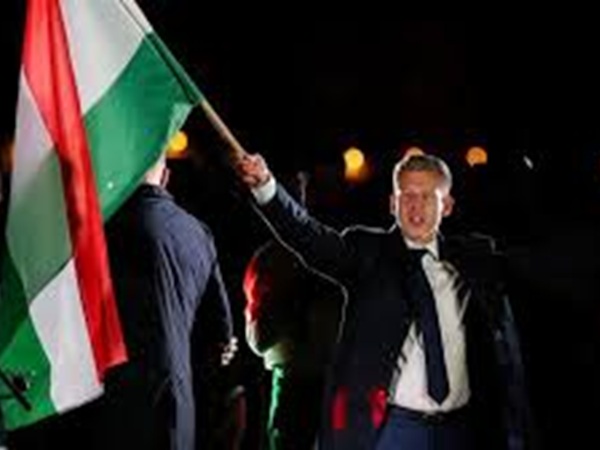
Péter Magyar’s opposition Tisza party has won a landslide victory in Hungary’s recent general election, putting an end to Viktor Orbán’s 16-year authoritarian rule. Mounting political and social tensions are reflected in a record 79.5% turnout. The result is widely hailed as a defeat for right-wing populism and authoritarianism in Hungary and across Europe, and as a setback for Trumpism. But as Western commentators draw broader lessons from Orbán’s defeat, they risk overlooking the specific features of Hungary’s distinct form of right-wing populism.
This in turn is rooted in Hungary’s transition to capitalism. While capitalist restoration in Russia saw the formation of powerful oligarchic groups based on their control of natural resources, Hungary’s ruling class, like other former Eastern Bloc countries in Central Europe, oriented itself toward Western capitalism. This took the form of the wholesale adoption of neoliberal policies, promoted and enforced by institutions such as the EU, the IMF, and the World Bank, and deepened through EU and NATO membership. Western capital came to dominate key sectors of the economy, integrating Hungary into European value chains as a source of skilled but low-paid labour. Bourgeois democracy and the “rule of law” provided the stable framework for this process.
The neoliberal paradigm – based on privatisation, deregulation, and cuts to welfare provision – initially faced little opposition. After the 2008 Global Financial Crisis, however, the MSZP–liberal coalition was discredited by austerity policies and political crisis. Growing discontent paved the way for the rise of Fidesz.
In the 2010 elections, Fidesz channelled this anti-liberal and anti-austerity mood, securing a two-thirds parliamentary majority that allowed Orbán to change the constitution and cement his rule.
Nationalism played a central role in this process, redirecting social discontent away from confrontation with capitalism and toward targets such as foreign capital, European Union institutions, and domestic liberal elites. This allowed Orbán to consolidate a new political order through targeted redistribution policies and the restructuring of the state, bringing key institutions, including the judiciary and much of the media, under political control. However, this redistribution was not primarily directed toward the poorest, but toward building support among the middle class and consolidating a domestic bourgeoisie tied to the regime. It was accompanied by measures that reduced welfare provision and expanded low-paid public works schemes for the unemployed, placing the burden increasingly on poorer groups.
At the same time, the regime moved to reduce the dominance of foreign-owned capital in the economy, presenting this as a defence of “national sovereignty”. Orbán built political patronage by placing loyalists within state-linked firms and financial institutions, while state resources were channelled – through preferential treatment, public procurement, and corruption – into private networks aligned with the ruling party. The distinction between state, party, and capital became increasingly blurred.
This was particularly evident in the restructuring of the banking sector, which aimed to increase domestic ownership and strengthen Hungarian capital within an economy that remained structurally dependent on Western capital. A similar process could be seen in the “repolonisation” of banks under Law and Justice in Poland.
Bonapartism
The Orbán regime may be understood as a form of bonapartism. In the classical Marxist sense, bonapartism refers to a situation in which the state acquires a relatively autonomous position in relation to the main class forces, balancing between them while ultimately defending the conditions of capitalist reproduction. While originally developed in relation to inter-war Europe and moments of acute political crisis, the concept can be extended to conditions of neo-colonial capitalist development, where the bourgeoisie is fragmented and no stable hegemonic fraction of capital is able to fully dominate the state.
In Hungary, and later in Poland under Kaczyński’s Law and Justice, the dominance of foreign capital and the absence of a consolidated national bourgeoisie allowed the state to gain relative autonomy, rather than act as an instrument of a unified ruling class. The Orbán government achieved this by balancing between European and global capital on the one hand, and popular discontent generated by neoliberal restructuring on the other.
This also had a geopolitical dimension. The regime manoeuvred between different imperialist blocs, increasing its energy reliance on Russia and pursuing investment and infrastructure ties with China, while remaining dependent on Western capital. This was framed in the language of “national sovereignty”.
In this sense, its rule does not derive from any dominant class fraction, but from the attempt to mediate between contradictory internal and external pressures while reorganising the state and domestic power relations.
Eroding support
However, the Orbán regime came under increasing pressure in the years before the election. Economic stagnation, high inflation – especially in food and energy prices – and falling real wages made it harder to maintain the improvements in living standards that had helped secure its earlier support. The freezing of EU funds over rule-of-law disputes also slowed public investment and reduced one of the key sources of economic and political stability.
Corruption became harder to ignore. The close links between the state and politically connected business networks, long treated as part of the system, increasingly fuelled public frustration and weakened the government’s narrative of national renewal.
The period from 2022 to 2024 was marked by sustained labour unrest in Hungary, as the government used “emergency powers” to restrict the right to strike. Teachers, health workers, and other public sector employees entered into conflict with the state over wages, working conditions, and chronic underfunding. Alongside this, broader anti-government protests emerged around corruption, media freedom, and democratic and LGBTQ+ rights, culminating in demonstrations following the government child abuse scandal.
Who is Péter Magyar?
Péter Magyar, a former insider of the Fidesz political and administrative elite, broke publicly with the party in 2024 after a high-profile scandal involving a presidential pardon granted to a man convicted of abusing children in a state-run home. The case triggered political outrage, particularly because it cut across the regime’s self-presentation as the defender of “Christian family values”.
What gave Magyar immediate political weight was not only the scandal itself, but his position within the system he was now criticising. He presented himself as someone who knew how power actually worked inside Fidesz: how political loyalty, personal networks, and access to state resources had been used to build careers and fortunes. This insider-outsider position allowed him to break through in a way the established opposition parties had been unable to.
His support grew rapidly, with the traditional liberal opposition already weakened and discredited. Soon, Tisza eclipsed the opposition by tapping into the collapse of Orbán’s social contract, which had favoured the provincial middle class at the expense of the poor. As growth flatlined at 0.3% in 2025, rising living costs undermined the regime’s capacity to sustain these social compromises. Consequently, the provincial middle class, which had previously formed a key part of the Fidesz regime’s social base, began to view the system as a closed shop for well-connected insiders rather than a source of stability, making them more receptive to Magyar’s promise of a merit-based economy.
This was reinforced by a massive youth vote on 12 April, where nearly two-thirds of voters under 30 backed the Tisza party. For this generation, the government’s focus on ‘culture wars’ was a poor substitute for real professional opportunity. By turning out in record numbers, they rejected a patronage-based system where success depended on political ties, choosing instead a pro-European future they felt offered a genuine chance to get ahead.
With the economy stagnating and living standards under pressure, Magyar’s immediate priority is to secure the release of around €19 billion in frozen EU funds, which would likely come with conditions linked to fiscal discipline and compliance with EU rule-of-law and economic governance frameworks, including pressure for spending restraint and cuts in public finances.
Magyar would need to reverse or significantly roll back the structural changes introduced under Fidesz, particularly in relation to the judiciary and other key state institutions in order to release the funds. He does in fact hold a constitutional two-thirds majority, which formally opens the way for such a substantial institutional and constitutional shake-up. But the real question is how far he is prepared to go down this road, and how deeply these changes have become institutionalised over the past decade.
Magyar’s victory has been presented in parts of Western commentary as a return to liberal democracy after the Orbán period. But this is a misleading interpretation. His programme does not represent a break with the existing political framework in any progressive liberal sense.
On key issues he remains within a broadly conservative framework. He supports a restrictive approach to migration, in some respects even more restrictive than Orbán’s earlier position. On questions such as LGBTQ rights and abortion, there is no indication of significant change: Magyar’s approach points more towards continuity than liberal reform.
On foreign policy, his position is also shaped by pragmatism rather than any broader realignment. Hungary’s dependence on external energy sources means that relations with Russia cannot simply be broken, and Magyar has signalled a continuation of a pragmatic approach to both Russia and China rather than confrontation.
Taken together, this is not a return to liberalism in any meaningful sense. What we are seeing is a pragmatic reshaping of the existing political model under new leadership.
Tasks of the left
Despite the expectations placed on Magyar, he offers no way out of the underlying problems facing Hungarian society. Like Orbán, he remains within the same structural framework of Hungarian capitalism: dependence on foreign capital and integration into the European economy.
There is a danger that when disillusionment sets in, the left might not be in a position to capitalise on it. A similar dynamic can already be seen in Poland, where after the fall of Law and Justice a liberal-centrist coalition has presided over rising far-right support, particularly among the young people.
Despite its current marginalisation, the Hungarian left must maintain its political independence. Magyar’s new government cannot be supported. The left must resist alliances with liberal parties or subordination to “anti-Orbán” unity. It must be prepared for a renewed struggle against austerity and attacks on labour protections. Above all, it should develop a programme aimed not at managing capitalism, but at its socialist transformation.