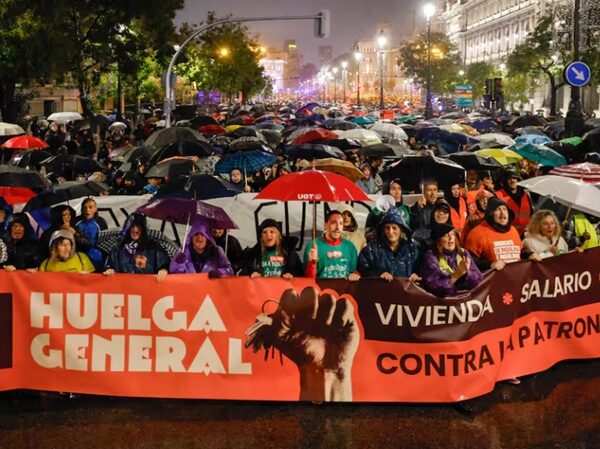
There are moments in history when seemingly isolated events are the sparks for mass movements. On September 23rd, 2026, María del Carmen Abascal Martín, a working class pensioner was evicted from her flat in a violent police operation. Demonstrators organised by the Sindicato de Inquillinas (Tennant’s Union) were attacked by riot police. Working class people were outraged and solidarity protests spread throughout the Spanish state, including a ‘Homeless Camp’ in the main square in Madrid, the Puerta del Sol.
The anger spread like a lightning bolt throughout society due to the housing crisis which means people like Maricarmen and working class families are evicted by speculative vulture funds and the banks. Millions of young people have no prospect of obtaining a home of their own due to low salaries and are therefore forced to live with their parents.
The death of Maricarmen on Oct 7th due to her trauma took the movement to another level. Protests spread and the Sindicato de Inquillinas called for radical solutions. They said: ‘Housing must be a basic necessity, not a market commodity, because the two are incompatible.’ They called for the construction of at least one million social housing units and for a Temporary Solidarity Tax on Large Fortunes, so that large estates are subject to a minimum tax rate of 3 per cent, and to eliminate the dual nature of personal income tax by incorporating income from savings into the general tax base.
Furthermore, the Sindicato is raising the possibility of expropriating homes when they are put to a ‘non-social use’. As explained by its spokesperson, Alicia del Río, this proposal is not aimed at those who own a flat by the beach or in their home town or village, but at those who fail to comply with the primary use of a property, which must be residential. ‘We are referring to illegal holiday lets, empty flats, and those fraudulently let as short-term rentals…’, she explained. Through these measures, they believe that 700,000 flats could be ‘freed up’ – flats that have currently been ‘taken off the residential market’. In the case of large investment funds or banks, expropriations could be carried out without any compensation being paid.
These and other radical measures are logical and are probably supported by a majority in society.
Pedro Sánchez and PSOE take their chance
Under massive social pressure the minority government led by Pedro Sánchez proposed limited measures to solve the housing crisis, such as a moratorium on evictions until 2030. The reforms were widely seen as not going far enough and due to the Basque Nationalist Party PNV (a right wing party) not voting in favour, PSOE’s measures were defeated in the Congress. Sánchez called a snap general election for November 29th on the issue.
However, due to the pressure from below the two main unions realised that the protests had to go on and so a general strike was organised for November 11th.
PSOE did not come out in favour of the strike but said they respected ‘the right to strike’ and suspended all election activities on the day. Meanwhile the PP and Vox viciously attacked the ‘Huelga Electoral’ (Electoral strike) Ayuso, the ‘Trumpian’ President of the Madrid Provincial government called on the PP leader Feijóo to put an end to ‘all this trade union rubbish’. Abascal, the leader of the far-right Vox party said general strikes would be prohibited when he is in government.
Historic General Strike
The strike was a massive success. The UGT and CCOO claimed it was a historic day of protest that exceeded all expectations.
There were picket lines and protests across the Spanish state. Up to 75 per cent of workers joined the strike in some regions, such as Andalusia and Aragon and in Catalonia it exceeded 80 per cent where public transport was paralysed.
The union representative of the food industry division at CCOO, reported that participation in the general strike within this industrial sector was estimated at approximately 60 per cent particularly in the meat sector, ‘the driving force behind the food industry’, which began a week-long strike on the previous Monday to the general strike, had shown ‘considerable’ support for the strike, led by flagship companies such as El Pozo and Campofrío, but also including other firms and sub-sectors.
The strike was also felt at the ports of Algeciras, Valencia, Barcelona and Tarragona. Metalworkers – who have been on indefinite strike since Monday – once again blocked the port of Tarragona.
Mass demonstrations in very city
Despite heavy rain on the day, the Sindicatio de Inquillinas estimated 600,000 on the Madrid march alone and 400,000 in Barcelona.
Thousands of people took to the streets of Bilbao and the Basque capital Vitoria-Gateiz ‘against property speculation and for the right to housing’. The march, led by banners bearing the slogan in Basque ‘Etxebizitza eskubidea bermatzeko espekulazioari ez!’ (To guarantee the right to housing: No to property speculation!).
Unions highlighted that workplaces were ‘emptied’ and the streets of the Basque Country and Navarre were filled with people mobilising for the right to guaranteed housing ‘for everyone and for the entire working class’.
There was a historic and massive demonstration march through the streets of central Valencia in the rain which served as a ‘wake-up call’ to all governments, present and future. ‘It won’t be the last, of course. Not until the problems facing the working class are resolved,’ the trade unions warned. This underlines that the mass movement will most likely continue after the general election whatever the result.
Participation of young people
It was noticeable the high number of young people participating. They chanted slogans that have become commonplace at strikes for the right to housing, such as ‘What’s going on? What’s going on? We don’t have a home’, ‘Here are the anti-fascists’ and ‘Long live the working-class struggle’.
In interviews many protesters pointed out that rent should not take up virtually their entire wages, and many called for a rent strike: ‘We want to ask the landlords: how long can you hold out if we all stop paying you?’
Police and state violence
The general secretaries of CCOO and UGT, Unai Sordo and Pepe Álvarez, condemned the police charges and the use of pepper spray. During the strikes and demonstrations the police arrested at least 52 people.
Pepe Álvarez, also warned that the National Police ‘are obstructing the constitutional right to strike’ and restricting the right of pickets to inform their workmates about the issues regarding the strike.
Patricia Ruiz, UGT’s executive secretary for occupational health and safety, highlighted the difficulties faced by pickets in informing workers at the depots of Madrid’s Municipal Transport Company (EMT) and the assaults carried out against them by National Police officers.
The left-wing Podemos candidate for the 29 November election, Irene Montero, has called for the resignation of the PSOE Minister of the Interior, Fernando Grande Marlaska, over the conduct of the police officers: ‘We have witnessed police violence, unjustified identity checks, the use of pepper spray and batons’.
In the aftermath of the strike the press and right-wing parties are concentrating on the looting, vandalism and lighting of fires in Barcelona after the main protests to deflect attention away from the issues brought to the fore during the strike.
This tactic of the state has almost become a cliché and is seen through by millions of workers and youth.
Banners and placards were seen on the protests declaring ‘The real violence is not being able to make ends meet’
General Election November 29
The latest government opinion poll – Centro de Investigaciones Sociológicas (CIS) gives PSOE a 12 point lead over the PP. However, all the private party polls predict a PP/Vox majority on November 29th.
How is this possible, given the mass movement around housing and the successful general strike? It remains to be seen how much of a bounce PSOE can get from the strike and what it has revealed but it is true the right can simply say, ‘what has Sánchez done since he has been in power’?
The parties to the left of PSOE suffer from fragmentation. The fact that the Frente Amplio (Broad left front led by Ada Colau, the ex-leftwing mayor of Barcelona), Podemos and other regional parties are standing separately is detrimental to the distribution of seats within this bloc.
Vox and PP have a simple message, ‘yes, there are problems but they’re the fault of PSOE who have done nothing since being in power and if we repatriate immigrants, we’ll solve all our problems’. It hasn’t helped PSOE that the party has been mired in corruption cases including the ex-PSOE president Zapatero.
National Question
The Spanish state is diverse and so election results are not uniform throughout the state. Polls are predicting a clear victory in the Basque Country for the first time for the left nationalist party BILDU (formerly the banned party Herri Batasuna which was connected to ETA).
In the scenario where the PP has to allow Vox into the government the national question will be exacerbated. Vox have declared that in government they will insist that the Basque language will lose its position in the bilingual Basque education system and they will push for the Basque ‘Diputaciones’ (County Councils) to lose their right to raise taxes and that all taxes will be sent to Madrid directly. This would be a direct attack on the autonomy of the Basque Country and the Basque health service. These and other measures would be a recipe for confrontation between Madrid and the Basque Country.
Victory for the right – a blow to the working class
It is clear that a victory for PP/Vox on November 29th would be a blow to the working class. Given the distrust and disappointment in PSOE and the difficulty for left-formations to win parliamentary representation due to their fragmentation, this scenario is entirely likely. The entry of the neo-fascist Vox into government would however break a psychological and historical barrier.
It would open up a new period where the ultra-right would be in a position to try and implement their programme. They propose ‘Economic deregulation and remigration.’ This would mean attacks on workers’ rights and the discrimination of immigrants and the possible expulsion of up to a million migrant workers. They also have committed to overturning the progressive Trans Law and removing funding for women’s equality programmes and prohibiting the use of terms, ‘Gender based violence’ and ‘Violence against women’. They would obviously take no measures to alleviate the housing crisis as they are partly financed by some of the Vulture Funds.
Clearly, Spanish capitalism and big business would not stand for thousands of workers being removed from the workplace. Industries such as Agriculture, Hospitality and Construction would literally collapse without foreign workers. The health and care services would be unable to operate if Vox carried out their programme. However, at the very least they would encourage institutional discrimination which will lead to physical attacks and cut across working class unity.
It also remains to be seen the reaction of especially young women if a PP/Vox government attempts to turn back time regarding their hard won rights and their ongoing struggle against gender violence, given that only a few years ago the Spanish state was the centre of the feminist movement worldwide.
The November 11th strike has shown that despite the fragmentation of the left a significant section of the working class have shown they are prepared to struggle and have sketched out the outlines of a fighting programme.
The movement sparked by the eviction and death of Marciarmen uncovered all the anger of the working class on the housing crisis and forced the unions into action and in that process the demands became generalised to include pay and pensions.
The demands which came to the fore on November 11th indicate a developing consciousness amongst the working class and youth. The strike also has an important lesson, as the day after the Spanish parliament passed a decree which will guarantee present rent contracts will stay in force until 2030, meaning that most evictions will stop, although the Basque right-wing party PNV voted with the PP and Vox to block another decree which would have meant the automatic renewal of tenancies with a rent freeze. The lesson being that mass action can force change and that the right are on the side of the exploitative landlords and vulture funds.
Whatever the result of the general election; La lucha seguirá… / the struggle will continue….