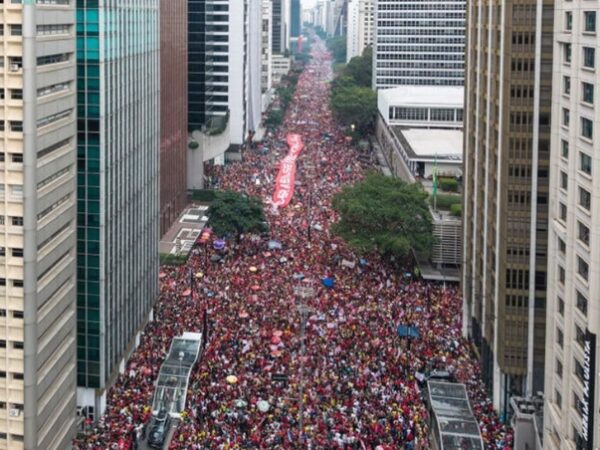
With Lula’s historic turnaround in the second round of elections, driven by millions of people taking to the streets in massive demonstrations with significant youth participation, discussions have once again turned to the importance of mass movements in Brazil and their influence on the direction of society.
is article was translated and adapted from original in Portuguese published at October 28 in marxismorevolucionario.com
The street demonstrations organised across Brazil in recent weeks brought together record-breaking crowds, representing one of the largest mass movements in the country’s history. Particularly on October 11 and 24, millions took to the streets, with hundreds of thousands gathering in each major city to attempt what the press called an ‘electoral miracle’ – that is, to overturn Lula’s disadvantage in the first-round results. The demonstrations were not organized by the campaigns themselves, but driven by young people and sectors of the working class, many of whom had no previous experience in social movements.
The first round, held on October 4, had given the victory to Flávio Bolsonaro, son of former president Jair Bolsonaro, who is now imprisoned for the attempted coup in 2023. This caused great concern among the left and progressive sectors of society, given the well-known policy of harsh austerity, environmental destruction, repression of minorities, and coup-mongering politics represented by Bolsonarismo. A second-round campaign then emerged from the grassroots, going beyond the official campaign of the Workers’ Party (PT) in an effort to turn the election around. Just a few days later, millions were already in the streets protesting and urging people to vote for Lula.
The bourgeoisie and its media outlets constantly try to convince people that these movements have little effect, following a liberal logic of individual persuasion through arguments and “proposals” that supposedly guide society’s course. On the other hand, many of the left’s more sectarian sectors see these street demonstrations as insufficient because they do not directly attack powerful enemies, often conjunring up fantasies of an armed struggle or physical attacks on banks and other institutions.
During the campaign, many people also wondered whether these demonstrations could persuade anyone. There was an honest debate as to whether they would reach undecided voters who might vote for Lula in the second round. Some placed greater faith in one-on-one conversations, setting up small stalls with coffee and cake and having activists who were not visually identifiable as such, trying to persuade people in public places.
What are the effects of the mass movements ?
Bringing millions onto the streets demonstrates the conviction and determination of those taking part and, therefore, social strength – the capacity to influence every sector of society. During the second-round campaign, the crowds’ message was clear: defeat the far right and win further gains for the working class. The campaign to end the 6-days-on/1-day-off work schedule, reducing the working week from 44 to 40 hours with two days off, was awaiting the outcome of this “balance of social forces” in the Senate. The proposal was put to a vote soon after the October 11 demonstrations, with the far right’s consent as well. Indeed, it is common for victories for the working class to occur under right-wing governments or in right-wing-controlled congresses as a result of pressure from mass movements. Given the social composition of the demonstrations and their demands, they clearly constituted a working-class movement, with a new element: young people, who in recent years had not participated on a mass scale in street protests in Brazil.
When millions take to the streets, even people who are not interested in politics are swept up in the movement’s atmosphere. A period of social catharsis emerges, during which society’s direction can change dramatically. The big bourgeoisie and its representatives in the media become concerned and often change their tone: the movement may persuade more people to take up demands further to the left. More often than not, these sectors give up a few rings to avoid losing their fingers: they bow to the mass movement and try to distort it before it is too late. Small and medium-sized business owners see the movement at eye level and witness their own employees’ enthusiasm, they may even see some of theirown demands being met. The Bolsonarist camp loses heart, becomes disorganizedfalls into disarray, preferring to hide in the face of the inevitable – or else, in desperation, resorting to violence in a disorganized way.
Most important, however, is the involvement of working people who see the movement as their own cause. Where there had been apathy and hopelessness, people can see through mass mobilization that they can help bring about changes in their own favor, as happened with the move to end the 6-days-on/1-day-off schedule. Nowadays, with the working class deeply fragmented and most workers unable to rely on their trade union organizations, mass movements are often the only way to bring millions into the struggle. And it is in the streets that the organized left can finally engage with these million, something that the routines of everyday life normally prevent.
The next step is even more important: building awareness that workers organized in the streets can wrest concessions from governments and bosses. Demonstrations along avenues are no longer enough: organization is also needed in workplaces and places of study, along with neighborhood assemblies, strikes, occupations, and road blockades that put the ruling class under pressure and cause loss to them. Organization and political consciousness grow around the idea of workers’ self-government as the struggle grows and takes deeper root, potentially, developing into a revolutionary process. The logic of mass movements has always been central to Marxism and the Russian Revolution. Lenin opposed ideas that existed, and still exist, within our class that advocate radical actions by small groups or individuals, including attacks or armed groups detached from the working class’s actual organization.
The bourgeoisie and imperialism are well aware of this and fight our class’s mass movement every day. Part of this effort involves police repression and portraying the movement as violent and chaotic. Another part involves discrediting it and using a liberal ideal to promote the idea in the media that taking to the streets is pointless. Much of the more moderate left shares a similar view: left-wing governments bring progress, but mass movements should merely serve as a support for those governments, keeping the streets passive and within limits while defending the “democratic state under rule of law,” its stability, and its rules.
Since 2013 in Brazil, when young people took radical action against police violence and demanding rights, the streets have become the main arena for determining political outcomes. Bolsonarismo also grew in the streets afterward, and its mass demonstrations, especially in 2015 and 2016, led to the coup against Dilma Rousseff, the Workers’ Party former president who had succeeded Lula years earlier. History shows how working-class mass movements shape the course of events and, most importantly, how they can grow into revolutionary processes. In France and other European countries today, new youth movements suggest that this is a way to change the course of history. In times of systemic crisis, agreements made in palaces by the elite or tycoons increasingly fail to determine the future. The working class’s capacity to organize can increasingly set new revolutionary processes in motion. Today’s mass movements are the first step.
The Lula government and the mass movement
The election was not decided in the streets alone. Other factors also contributed to the process, in a dialectically interconnected way. Much has been said about ‘Lula’s Army’, a WhatsApp channel with more than 10 million members led by André Janones, a center-left congressman – there was a huge mobilization on social media spearheaded by him. Another factor was Lula’s longstanding popularity and charisma among the masses, as well as the social policies of PT governments, which had a major impact over the past two decades. On the other hand, there was also rejection of the far right and the Bolsonaro family. Personal conversations and persuasion, along with the PT’s overall campaign, also played a role. Now, as the election results are assessed, a debate is opening within the left and working-class organizations about these factors and the next steps.
The PT’s strategy is to praise the mass movement while arguing that it needs the movement to be able to govern. At the same time, it has already begun talks with the financial markets, which are also wielding their own weapons and have driven the stock market down in recent days. Given the PT leadership’s record and political project, further conciliation with the right is to be expected, based on the argument that there is no way forward with a Congress dominated by Bolsonarismo.
The PT governments – Lula’s three terms (2003–2010 and 2023–2026) and Dilma Rousseff’s one and a half terms (2011–2016; her second term was cut short by an institutional coup by the right) – were marked by class conciliation and accommodation with the right. On the one hand, they implemented impactful social policies that substantially changed the lives of the poorest sectors of the population. On the other, they maintained a liberal economic policy that ensured record gains for banks, agribusiness, and major investors, as well as astronomical profits for private-sector companies that administered social policies. Amid economic crises, the right wing radicalized under Bolsonarismo, while the left failed to build a radical alternative to the PT, which kept the working class contained and under its leadership.
Thus, Lula and the PT use the mass movement when it suits them, while always insisting that its limits must be set by the “democratic state under rule of law” and that it must not cause instability. Over the past four years, this strategy has left the movement with its hands tied and allowed Bolsonarismo to reorganize and win the first round, even though its leading figure, Jair Bolsonaro, was imprisoned for the attempted coup in 2023.
The movement that has emerged in recent weeks around the world will not stop; it can grow and take more permanent forms of organization. In Brazil, Lula emerges with considerable sympathy and mass support. However, it is important to recognise that his strategy does not allow for the growth of an independent mass movement of the working class, one capable of winning more rights and building the process of radical transformation that we need. An alternative left must be built on the basis of these struggles, with a program independent of the government that addresses the people’s problems and advances a revolutionary project in Brazil.