In January, sixty heads of state and eight hundred corporate bosses flew in their private jets to Davos in Switzerland to meet behind closed doors at the “World Economic Forum. They arrogantly claimed to be “strengthening global cooperation to tackle transnational challenges” without listening to the voice of the billions who suffer the effects of their crises. Their confidence was not high, as the WEF had to grapple with the deep and rapidly expanding chasms in the global order caused by the inability of capitalism to develop the world, or deal with the instability caused by Trump.
Trump visits China
Expectations from Trump’s Summit in Beijing with Xi Jinping, initially postponed due to another crisis in the US/Iran conflict, were modest and the results did not even live up to them. Trump naturally boasted about how the Summit had demonstrated what a great “master negotiator” he was, whilst Xi claimed that it had shown that China was an equal partner to the US.
Trump’s initial, dramatic increase of tariffs on Chinese goods was reduced during the truce in the trade war. But nothing was said during the summit about extending the truce, while China said it would be good to do so. The US claimed that its concerns on mineral (rare earth) supplies would be addressed, while China said it would maintain what it described as ‘lawful export controls’. The US hoped to sell 500 Boeing aircraft, eventually only 200 were agreed on condition that China would get jet engines in return. Both sides agreed on the need to open the Straits of Hormuz, while Trump’s decision to present sales of arms to Taiwan as a “very good negotiating chip” was met by China’s warning not to cross any red lines.
Putin visits China
Days later Putin arrived in Beijing. Each successive Sino-Russian Summit has delivered less than the previous one. Following the US-China Summit, the joint declaration implicitly criticised the US desire for unilateral hegemony, and committed the two leaders to cooperate in establishing a multilateral world. But this was little more than ‘strategic propaganda’. The twenty bilateral agreements which were signed, only one of which – the extension of the cross-border railway – potentially has any immediate benefit. The remainder were related to issues of research, custom regulations, films, sport and scientific research. A major agreement to proceed constructing the “Power of Siberia 2” pipeline, pushed by Russia since 2006, was again put on the backburner.
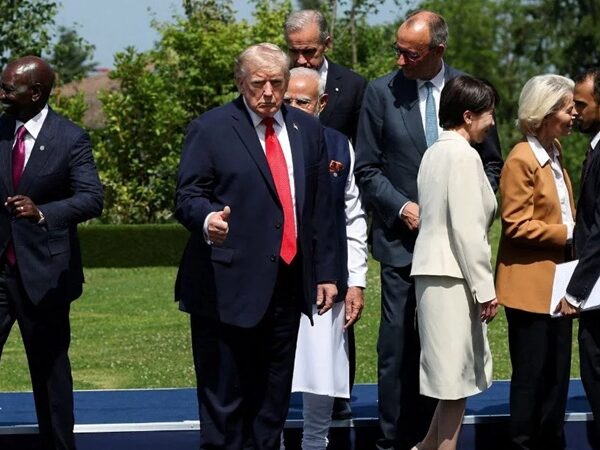
Maybe the timing of the G7 Summit in France was fortunate – rescheduled to avoid Trump’s birthday celebration in Washington, and when it appeared a ceasefire agreement with Iran had been reached. Trump arrived in his usual blustering arrogance, announcing as he walked into the room that “I am the boss!” The main achievement of the Summit appears to have been that Trump stayed till the end. Under Macron’s guidance, the other G7 leaders spent the week kissing up to Trump, persuading him to agree a common statement on Ukraine, while holding back from any direct criticism. A final symbol of sycophancy was the state banquet held in the Versailles Palace at which Trump demonstratively signed the ceasefire agreement with Iran. Trump seems to have missed the irony of the venue.
Economic and environmental costs of war
While signing the agreement with Iran, Trump claimed to have prevented a global depression by avoiding a long-drawn out war. Undoubtedly, if the war which Trump and Netanyahu initiated had escalated, the higher prices for oil, gas, fertilisers and other crucial products that transit the Strait of Hormuz would have done serious damage to the economy. But even now, Trump has succeeded in pushing the world to the edge of a new crisis.
The OECD now forecasts two possible scenarios – one for a time-limited disruption, the other for a prolonged disruption. In the latter case it predicts global GDP growth falling to 1.8% in 2027 – well below the normally accepted marker for a global recession. Countries in Asia and Africa will be worse hit as inflation escalates, commodity prices become restrictive, bank lending becomes more expensive and debt levels increase.
The consequences of Trump’s actions are also felt in the US. In February’s State of the Union address he claimed that gas (petrol) prices had fallen below $2 a gallon in some states. Now prices range from $3.3 to $5.6 – further undermining the confidence of his voter base to deliver on his promises.
Huge damage has been and continues to be done to the environment by the wars in the Middle East, Ukraine and elsewhere. Trump’s contempt for actions to restrict climate change, and his greed for oil is summed up in his call to “let the oil flow” through the Strait of Hormuz. One F35 fighter mission emits more harmful greenhouse gases than a typical car in ten years. Oil refineries and infrastructure objects are burning across the Middle East, Ukraine and Russia. These crimes against the environment will dramatically exacerbate the effects of “Super El Niño” which is already building in the Pacific, threatening large parts of the Global South with floods in some places and droughts in others.
US imperialism knocked back
Whatever the deluded sycophants around Trump may believe, the joint Israeli/US attack on Iran has been a disaster. It failed to either bring down the regime, or force any serious regime change. Power has now moved firmly into the hands of the more hardline IRGC. No new concessions related to its nuclear program have been wrested from Tehran. The Strait of Hormuz is now under the joint control of Iran and Oman. Up to $300 billion has been promised to rebuild Iran, and huge damage has been done to the world economy.
The cost for US consumers and taxpayers is already over $132 billion and growing. America has increased its alienation from its allies, whether in Europe or the Arab world. They may not break completely with the US, but they no longer trust it, and want to build their own, independent defences.
Despite this, there is no guarantee that the military phase of the conflict is over. With elections looming in Israel, Netanyahu is under pressure from both the far-right around Smotrich and Ben-Gvir, and from the main opposition around former Premier Naftali Bennett who all accuse him of being soft on Hezbollah in Lebanon. The Beirut suburb of Dahiyeh “must tremble until security returns to the north” threatens Bennett. Despite Trump reportedly shouting at Netanyahu, the Israeli government is likely to keep breaking the ceasefire and undermining the US/Iran agreement. Increasingly the close relationship between the Israeli government and the elite of the Western world is out of step with the growing isolation of Israel and the disgust felt by growing numbers particularly the young at its genocide in Palestine.
This has been a disaster for US imperialism, further undermining its authority on the world stage. In Iran, Lebanon, and as a consequence of the continuing genocide in Gaza and settler violence in the West Bank, many thousands have lost their lives, many many more their homes and livelihoods. Any pretence at the beginning of the attacks on Iran that they were somehow to support the fight for democracy were quickly forgotten. Not only has the regime been, at least temporarily strengthened, it has continued its wave of executions and repression of opposition activists, the vast majority of whom are young.
Although a further open military confrontation between the US and Iran is now unlikely in the next months, this does not mean everything is over and the status quo will hold. Over the heads of and against the interests of the masses, military threats and trade sanctions will be used by the two sides as they argue over the reallocation of markets, finance, energy routes, and supply chains using the flow of traffic through the Straits of Hormuz as a bargaining chip.
Ukraine extends war to Russia’s heartlands
Thinking that the ceasefire agreement with Iran would hold, at the G7 Summit Trump suggested he would now turn to resolving the Russia/Ukraine war – in his usual mercantile manner he spoke of “a new quality of US-Russia relations”.
Following Russia’s invasion in 2022, the war has now lasted longer than WW1, much of which has mirrored the trench-based war of attrition of WW1, combined with the addition of 21st Century drone warfare. While many Ukrainians are desperate to see an end to the fighting, preferably with the full withdrawal of occupation troops, the majority of Russians simply want the war to end and don’t understand why it is continuing.
Despite its superiority in human resources and equipment, Russia is being forced back. Ukrainian forces are suffering high losses, and have difficulty recruiting but are now taking back more land each month than the Russians claim. The Russian army is releasing AI produced videos to suggest they are having success on the front. Ukrainian cities such as Kyiv, Sumy, Odessa have suffered four years of missile and rocket bombardment, now Russian cities are being attacked. St Petersburg, Moscow, Kazan and many other cities have experienced drone attacks on oil facilities. Moscow’s main refinery is so badly damaged it will not be restored until 2027. Petrol shortages are now very widespread, including in Moscow. Air-defence units are reportedly being withdrawn from the Ukrainian front to protect Moscow.
Most dramatic is the situation in Crimea, a Black Sea holiday destination and a major Russian military hub. Ukrainian forces are isolating the Peninsular from mainland Russia. Constant drone attacks, a ban on buying petrol, food shortages, electricity blackouts, internet shutdowns and curfews are making life unbearable. Tourists and many residents are fleeing Crimea in panic, eye-witnesses describe it as ‘hell on earth’.
Pressure again growing for negotiations
Patience is wearing out across the country – after the attacks on the Moscow oil refinery, one worker wrote: “If only you knew how at work our colleagues constantly talk about how shitty everything is and how everyone is freaking out and how everyone is fed up with everything.” German Gref, the head of Russia’s biggest state bank “Sberbank” has come out to say that the country is now like “a concentration camp”. He went on to say: “What worries, I think, us all, is one and the same. I do not think there is a single person in the country who has any other worry than the quickest end to military actions – that is obvious”.
Such public (although immediately removed from social media) criticisms from such an important pillar of the oligarch regime together with the worsening military situation is pushing both Foreign Minister Sergey Lavrov and Putin himself to talk of restarting negotiations. Still not prepared to make concessions, they insist on the demands they first raised in 2022! Trump has again started to activate discussions with Zelensky and Putin around the NATO Summit.
In his “Open letter” to Putin, Zelensky proposed to set a clear date to start negotiations, with a full ceasefire along the current front line for the duration of the negotiations. This reflects a growing section of Ukrainians who want the earliest possible end to the war. The Kremlin, seemingly supported by Trump, still insists that that part of Donbas which it has been unsuccessfully trying to annex for four years is handed over before negotiations start. If that was to happen, and it cannot be ruled out, it will give the green light for the Kremlin to demand even more Ukrainian territory during post-ceasefire negotiations.
In this context it is staggering how many supposedly ‘Marxist’ lefts, when opposing western imperialism, fall into the trap of supporting the ‘other side’, in this case Russian imperialism. ISA, for example, in their latest article, echo the position of the Kremlin and Trump by criticising Zelensky for refusing those “territorial concessions which almost certainly would be necessary for any sort of ceasefire to occur”.
Rather than forcing further territorial concessions Ukrainian and Russian workers desperately need an immediate ceasefire. This would allow the working class time to build and strengthen its organisations and political approach to defeat the regime in the Kremlin, force the withdrawal of Russian troops and create an alternative to the Ukrainian elite that has tied the country to the interests to western imperialism.
Multilateralism and polycrises
In Davos, the WEF drew the conclusion that ‘multilateralism is in crisis”. US’s withdrawal from international bodies such as WTO, WHO and UN bodies as well as a potential split in NATO, his attack on Venezuela and Iran, and threats against Cuba and Greenland have seriously damaged the global “rule of law” approach. His notorious “Board of Peace” consisting of various far-right politicians, oligarchs, authoritarian leaders and war criminals has not only raised none of the money promised to rebuild Gaza, but is now more concerned in establishing immunity for its members.
In this melting pot of international relations, each national bourgeois is increasingly looking after its own interests. They are turning to right-populism, and in those countries that are not already authoritarian, in an increasingly bonapartist direction. After eleven years of steadily increasing military expenditure, global spending (without the US) on arms increased by 9% in 2025. The once firm alliance between the US and western Europe is under severe strain. The latest example is their conflict over who should be the new [imperialist] “High Commissioner” for Bosnia-Herzegovina.
Not accidentally, Xi Jinping taunted Trump during the Beijing Summit by suggesting they should avoid the “Thucydides trap” – the idea that when a new imperialist power develops to challenge the power and wealth of the older dominant imperialist, there is an inevitable war. Historically, war often did occur, but when US imperialism pushed Britain out of its dominant position it did so without a direct, bilateral military conflict. The process started in the inter world war period, with the change in the balance of imperialist forces during WW2 combined with the US’s economic dominance and the Bretton Woods Agreement and drew to a close with the Suez crisis.
China’s continuing threat to US imperialism
In today’s world, it is easy to draw a one-sided conclusion about the role of China in the global situation. A section of the left are ‘campists’, they view the world through the prism of geopolitical conflict and express their opposition to the main imperialist power by siding with its opponents, idealising China as a form of socialism, or at least ‘anti-imperialist, definitions that could not be further from the truth.
Mainstream bourgeois commentators naturally have a more sober understanding of the dangers that Chinese capitalism/imperialism hold for the interests of Western imperialism. They no longer see China as a source of cheap, unskilled labour but recognise that it is quickly developing superiority in several key sectors such as AI, electric cars, and other high-tech products. In doing so, they do not necessarily understand the roots of such success. The centralised state and its control of key industries allow it to use some of the levers inherited from the Maoist past to avoid catastrophic failures.
The Evergrande collapse, accompanied by and triggering crises in other sectors, did serious damage to China’s domestic economy. The collapse of Lehman Brothers in 2008 – a blow equivalent to 4.5% of US GDP led to the 2008 global crisis and prolonged recession. So far though, the Chinese regime has managed to ride out the consequences of Evergrande which, it is true, delivered a smaller 1.7% blow to China’s GDP. As the Evergrande crisis unfolded articles started to appear in the western bourgeois media discussing the Japanisation of the Chinese economy. There was, of course, an element of wishful thinking, hoping that China’s growth would slow and western hegemony extended.
The lost decades that followed the Japanese crisis which hit in 1991 started with the collapse of a huge asset bubble. The stock market crashed in eighteen months from 44000 to 15000. A long period of deflation and economic stagnation followed. GDP slumped – both nominal GDP and GDP per capita in 2025 were still lower than in 1995. Japan’s share of the world’s GDP fell from 18% to under 4% . In 1989, 32 of the world’s top 50 companies by market capitalisation were Japanese. By 2018 only Toyota remained.
Whilst some elements of what is happening in China today – the fall in residential property prices for example – can be compared to what happened in Japan, there are other elements that do not support the Japanisation of China’s economy. Despite long term deflationary pressures and periods of actual deflation (2000-03, 2021-25) GDP continues to grow. Although there is doubt about how accurate the statistics are, China’s growth rate still exceeds the G7 average. The main stock market index, which dropped by almost a fifth after Evergrande, has since recovered and is currently in a bull run. China’s share of global GDP is continuing to grow.
There are growing contradictions within the domestic economy, not least the threat of a serious crisis of overproduction, but the dynamic is still pointing in the direction of China making further inroads in the global economy. Whilst a decade ago, the US, EU and China each had a 16% share of global GDP, the first two have fallen while China’s has grown to 20%. In the last twenty years China, which initially only dominated trade in a few nearby countries, has now pushed the EU and US out of their domination of trade in Asia and the Middle East, Eastern Europe, Oceania, a large part of Africa and Latin America. In the past few years China’s loss of trade with the US has been easily compensated by increases elsewhere. In 2025 China spent more than $220 billion in its Belt and Road Initiative – more than doubling the previous high in 2019.
New challenges
If China is to continue growing and increasing its influence, which is far from guaranteed, and the depth of the crisis of US imperialism worsens, then the world is on the cusp of another great paradigm change. It is clear that the next period is going to be one of increasing instability. The likelihood of new wars such as those in Ukraine and Western Asia will increase. Big steps have already been taken in the traditional ‘bourgeois democracies’ towards right populism and authoritarianism. As China strengthens its influence, that tendency will be turbo-boosted.
At the same time, the patience of the working class and oppressed masses is reaching breaking point in many parts of the world. Recent events in Bolivia and Albania, after the previous wave of GenZ revolutions ,will continue to challenge the ruling elite in many countries. This will present new challenges for the left and workers movement.