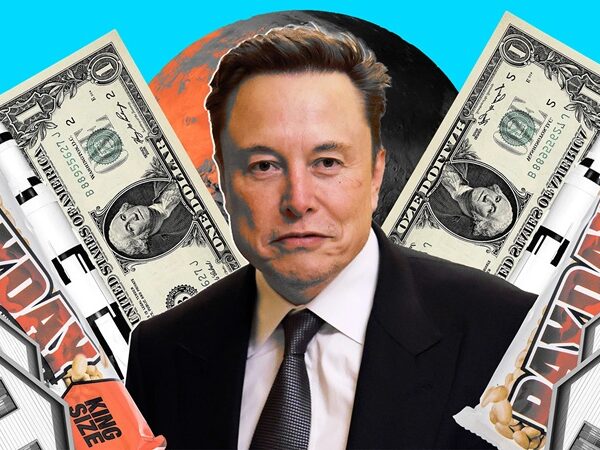
It’s not always easy to make sense of what’s going on in the world, but now and then history speaks loudly and makes big, obvious gestures. On 9 June, 27 Belfast families were driven out of their houses in racist riots. That very weekend the richest man in the world, who had publicly egged on the rioters, became the first trillionaire in history when his company SpaceX went public. Elon Musk is now worth 3% of the GDP of the United States – way ahead of the notorious ‘robber baron’ capitalists of US history, like Carnegie and Rockefeller.
Contrast that wealth to the image of humble terraced houses in Belfast being consumed by pogrom fires.
This is a double obscenity: first, that one person can amass so much wealth, and second, that this one person is Elon Musk. The truth about capitalism is now more stark and obvious than ever. One myth after another falls apart in the light of the rise of this raving fascist grifter to the position of richest human in all of history.
Myth #1: Capitalism rewards hard work and clever ideas
The story goes that under capitalism, hard work and clever ideas are rewarded with wealth. Musk has more wealth than anyone ever. But the other side of the equation doesn’t add up. Hard work? He posts and argues online all the time. He’s so lazy, he even hires people to play video games for him. Several major news outlets have reported on Musk’s intense, regular drug abuse.
Clever ideas? These include eugenics. He has ultra-creepy plans to spread his own, supposedly superior, genes through a ‘legion’ of offspring. He signs legal agreements with women he doesn’t know, gives them a pile of money and sends them his sperm in the post. Another clever idea he had was to attend parties at Epstein’s island, asking the notorious, convicted sexual predator: “What day/night will be the wildest party on your island?”
Musk’s online presence shows that he is the most painfully credulous public figure in the world. He will believe anything that far-right influencers tell him on the internet. He uses shameless bluffing to cover up his ignorance about the various topics he likes to drone on about, from Ancient Rome to Mars settlements.
He has a clear pattern of utterly failing to follow up on his big, bizarre promises. When Thai children were trapped in a cave in 2018, he claimed he was going to invent a machine to rescue them. It was pure nonsense. Instead, in one of the most depraved acts of his life, he tried to smear the heroic diver who actually rescued them.
This ‘genius’ promised driverless cars years ago, and did not deliver. He promised something called “the hyperloop”, and did not deliver. Again and again he predicted the outbreak of civil war in Britain. He hasn’t delivered on this, though it’s not from lack of effort. That’s to say nothing about his various wild promises regarding Mars.
Only ten years ago, Musk was being hailed as an environmental hero. That was before he gave massive support to far-right political forces which, backed by the fossil fuel industry, want to demolish eco-friendly policies. To give SpaceX its due, it did manage to cut down the cost of putting things into orbit – and followed this up by polluting the night skies with excessive numbers of satellites.
We should not forget the incredible business acumen and service to humanity that Musk showed during the turbo-charged ‘enshittification’ of Twitter. Then there was his noble crusade against waste in the Department of Government Efficiency (DOGE), where he cut funding to many crucial initiatives and vital public jobs. And just in the last few months, he has fought legal battles with various governments over his AI chatbot Grok creating child sex abuse material.
Myth #2: The market distributes wealth efficiently
This brings us to another myth about capitalism: that the market is the most efficient way of distributing wealth. If this were true there would be no billionaires let alone a trillionaire – nothing is more wasteful than the personal hoarding of resources that could be used socially.
The SpaceX Initial Public Offering (IPO), the episode which catapulted Musk to trillionaire status, disproves this idea hands-down. SpaceX is not going to set up a viable settlement on Mars, let alone build a ‘lunar economy’ encompassing three worlds, even in the next ten years and even with hundreds of billions of dollars to play with.
In 2022, Musk’s car company Tesla lost 60% of its value before recovering. In 2025, it lost 46% before recovering, underlining how volatile these things can be – with Musk’s own bizarre and erratic antics a key factor in this volatility. In this case, capitalism’s ‘efficient allocation of resources’ means giving the guts of a trillion dollars to a man who has a suspect track record when it comes to delivering on promises, in the service of a project that’s not feasible.
It would be naive to view the SpaceX valuation as the starting gun for a new space race. It should rather be viewed in the light of recent bubbles in areas like crypto and AI. Indeed, SpaceX has branched out into AI, so this is partly about the broader AI bubble. Other investors are more interested in satellite communications, or a merger with Tesla. But whether it’s satellites, AI or cities in the Valles Marineris, it’s not easy to see where the return on this massive investment is going to come from.
Another part of the explanation is that lots of the investors actually had no choice, due to complicated rules around index-linked funds. This means that your pension could now be tied up in the fortunes of SpaceX, without you ever having had a say.
Myth #3: Capitalism brings about progress
Another myth about capitalism is that a world without ‘fearless entrepreneurs’ like Elon Musk would be stagnant and regressive. How then to explain Musk’s deeply regressive opinions on every subject?
His chatbot Grok gives us a striking example of what capitalist ‘progress’ now means. AI researchers in France described symptoms of schizophrenia to Grok, which the chatbot confirmed was a ‘doppelganger haunting’, then advised them to drive an iron nail into a mirror while reciting Psalm 91 backwards. The source for this mental health advice was Malleus Maleficarum, a notorious witch-hunting textbook from 1486.
Here is a very literal warning that, when we entrust our future to philistine tech billionaires, we invite a return to dark ages of paranoia and fanaticism. This isn’t an isolated incident. Musk’s peer, fellow tech capitalist Peter Thiel, key funder of US Vice President JD Vance’s political career, delivered a lecture in San Francisco warning that the Antichrist is real, and may even be the climate activist Greta Thunberg.
One of the worst things about Musk is that he makes the other tech capitalists seem reasonable by comparison. But this whole class has a lot of the same hubris, instability and anti-social proclivities as Musk. For example, Amazon’s Jeff Bezos openly argues that people should endure water shortages in order to power data centres. He promises that the stolen water will power an AI revolution that will, down the line, solve every problem facing humanity.
What does all this mean for us? It means that the capitalist class is incapable of offering a progressive or positive vision for the future. If the likes of Musk and Bezos get their way, we will have a future where people die muttering verses from the Book of Revelations supplied by some bot as a quack remedy for extreme dehydration.
The socialist alternative
If capitalism does not reward hard work or good ideas, if it does not allocate resources efficiently, and if it does not lead to social or cultural progress, what has it got going for it?
The reality is that most of us work too hard, both in the workplace and in the home. We deserve to be rewarded with free, quality healthcare, childcare, public transport and education and public homes we can afford to live in. We deserve abundant clean energy.
The usual response is ‘Where would all the money come from?’ This is not really a serious question, in light of the fact that hundreds of billions of dollars can be found down the back of the couch for a James Bond villain. The key point about socialism as opposed to capitalism is that most of the wealth would be under democratic public ownership and control, and invested according to the most urgent human needs, instead of what we have now, which is investment driven by feverish cycles of mass hype and mass panic.
Don’t believe the hype
Of course, enough wealthy people still believe the hype, or at least believe other people believe it. One biographer of Musk called him a ‘real life Iron Man.’ Another biographer argued that Musk’s brashness and eccentricity are the price we have to pay for benefiting from this genius. Only it’s more than brashness, when Musk throws a Hitler salute at the inauguration of a far-right president, or when he uses his huge platform to broadcast intense hostility to people of colour, muslims, women, trans people and immigrants. It’s not eccentricity, it’s a delirious silicon fascism, with one eye on space and the other on antichrists and witches.
Capitalism just made this guy a trillionaire based on absurd promises. They’ve made him “too big to fail,” in the sense that someone will have to bail him out, at great cost, if and when he does fail. But if, against all the odds, he actually did deliver on his promises to colonise space, that would be far worse. It’s dystopian to imagine profit-driven corporations leading the way into space. Now imagine it’s one vast monopoly owned by Elon Musk. Imagine if we let this idiot do to Mars what he did to Twitter.