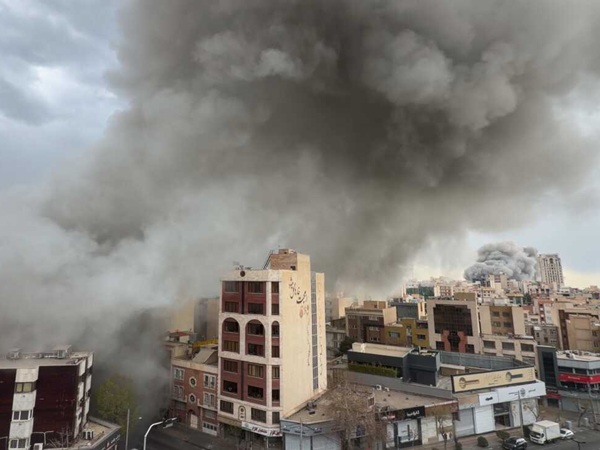
Last Sunday, US President Donald Trump announced the end of the 106 days of war that he and Netanyahu had launched three months earlier. Over 3,600 Iranians have been murdered in this war, as another chapter of Western imperialism’s bloody history in West Asia is written. This time, the potential outcome of this war poses a historic defeat for the US empire and the Zionist State. This is a defeat that socialists welcome, while at the same time having no truck with the capitalist theocratic government that rules Iran, which brutally represses its own people.
Barely was the ink dry on the paper when Iran announced the closure of the Straits of Hormuz. This was in response to the continued barbaric Israeli aggression and systematic ethnic cleansing in Lebanon in defiance of the Memorandum of Understanding. “All of Lebanon must burn.” Israel’s minister of national security, Ben-Gvir, wrote on X. Yet Trump has shown himself unwilling and unable to rein in the Israeli regime. Instead, Trump was reduced to making empty threats of hitting Iran hard, and even to kidnapping the Iranian negotiating team.
A fragile agreement
Such is the extremely fragile nature of the ‘agreement’, a deal filled with holes and ambiguities and fraught with difficulties, and with some parties, including the Israeli government, working to prevent a durable treaty.
From the viewpoint of international capitalism, it will take months for energy supplies to return to ‘normality’. The Chief Executive of Shell, Wael Sawan has stated: “You would require, we think, close to a year, if not longer, to be able to find equilibrium again.” And that is assuming the truce holds. The huge dislocation of the shipping fleets, the need to clear mines, the damage to offline oil wells, the damage to oil and gas plants, and a general lack of confidence and trust all work against a swift return to business as usual.
Beyond the 60-day truce, there lie huge obstacles in securing a tenable long-term nuclear deal. The 2015 JCPOA agreement, brokered by Obama and Tehran, was unilaterally ditched by Trump on assuming office in his first term in 2018. A new agreement will be much more problematic for the Iranian regime, which is now much less likely to eliminate completely a path to nuclear armament. Additionally, the JCPOA agreement was predicated on the lifting of sanctions, which, of course, never happened. Tehran is not likely to allow future compromises without sustained proof that the sanctions are history.
The signing of the Memorandum marks a humiliating setback for US imperialism. Of its war aims – regime change, the destruction of Iran’s nuclear programme and the elimination of ballistic missiles – none have been achieved, despite the cost in dollars, to the environment and in human lives.
A huge miscalculation
The adventure was based on the huge miscalculation that a bombing campaign could lead to regime change. In reality, the aerial bombardment served to give a fillip to the Iranian regime. In the meantime, the closure of the Strait of Hormuz was a devastating economic blow to the US and the world economy.
With Trump internationally isolated and unprepared to commit troops on the ground – an escalation which could have tied the US down for years in an unwinnable war – he was unable to fulfil his promise to Iranians that “help is on its way.” Faced with oil running out and the prospect of imminent world recession, he was forced to ditch Netanyahu, open negotiations and cede ground.
In the process, Trump has simultaneously shown himself as weak, but also as an interventionist President whose opposition to “forever wars” was only designed to be talked of during election campaigns.
The credibility of Trump, and of those ultra-right-wing and pro-Zioinst Iranians who came out to support him, especially Reza Pahlavi, has been significantly damaged in Iran and internationally.
Before this imperialist adventure, there was already growing opposition to the Israeli State within US society as a result of the Gaza genocide. This war will only add to that sentiment. The horrors of mass slaughter and famine have seen a major turn against the complicity of the US in the apartheid state’s crimes. This is particularly evident among progressive-minded Democratic voters, many of whom are young Jewish people, but it can also be seen within the Republican base. One factor that can motivate the latter, particularly its MAGA core, can be a sense that Israel has undermined US imperialism and support for its action goes against an “America First” outlook.
Despite its overwhelming military superiority in Lebanon, and despite Israel’s murderous transformation of village after village to rubble, and with a million people forcibly displaced, Israel has discovered that Hizbollah has regained much of its fighting capability after the devastating Israeli attacks launched on it in 2024. According to the Financial Times (20.6.26) : ”The militants had used the interwar period to rebuild and reorganise, their lingering military capabilities taking many Israeli military officers by surprise.”
Strained relations
Trump’s exclusion of Israel from the negotiations reflects the increasingly strained relations between Washington and Tel Aviv. Responding to criticism of the deal, Vice President JP Vance said: “Over the last three months, two-thirds of the defensive weapons that have protected your homeland have been built by American hands and paid for by American tax dollars… .anybody in Israel who thinks their biggest problem is the President of the United States needs to wake up and smell the reality.”
The most important war aim for Trump became the reopening of the Strait of Hormuz – a problem that had not existed prior to the launch of the war, as many Western leaders are keen to point out, not always in private. Even assuming the Strait is reopened, who is left in control? The wording of the memorandum clears the way for Iran to charge for use of the Strait, together with Oman.
Meanwhile, a $300 billion fund for the reconstruction of Iran is apparently to be created. Under pressure from hawks from within his own Republican Party, Trump is now backing away from saying that either the US or gulf states will create the fund. But even if the question of who funds the fund isn’t settled, this, plus the undertaking to lift sanctions and to unfreeze assets, together with the promise not to interfere in Iran’s internal affairs, all represent, at the least, a major propaganda victory for Tehran.
Conclusion
Both sides need to play to their domestic audiences. Yet both sides desperately need the deal to stick. The Iranian regime requires the prospect of economic stabilisation and growth, to tackle rampant inflation (running at 80%, with food inflation at 130%), unemployment and the cost-of-living crisis. The regime is extremely aware of the popular discontent that burst forth so dramatically in January, and which was suppressed so bloodily.
There is continuing conflict between hardliners, including the new Supreme Leader Mojtaba Khamenei, and those ‘reformers’ around President Pezeshkian, who has been the principal advocate of the deal. For the time being, Pezeshkian has held sway. Pezeshkian has offered guarded support for a softer approach on issues such as Islamic dress. “Some of the people who come out onto the streets in support of their homeland are the same people we previously sought to penalise with fines,” he said last month.
However, it is also true to say that the hardliners feel emboldened by events. This is also reflected in the measures taken against those deemed a threat to the regime…and not simply royalists, or spies, but the many young people, women, LGBTQ+ people who are arrested and persecuted for just trying to live their own lives. An Iranian singer, Parastoo Ahmadi, and members of her team have reportedly been sentenced to 74 lashes for performing in a concert without wearing a hijab.
Although the regime may have bought time with the defeat of Trump and Netanyahu, the underlying causes of mass popular alienation from it – amongst young people, women, LGBTQ+ people, national minorities, in the cities, in the schools and universities, and increasingly amongst working-class communities – are not going to simply disappear. But it is also clear that their discontent cannot be switched on and off on the whim of those governments whose reactionary agendas serve only the rich and powerful and not the mass of the Iranian people.
Revolutionary change in West Asia
The outcome of this war will be a further weakening of US imperialism and capitalism, both at home and abroad—it is a major blow to Trump in particular. Many, outraged by the Gaza genocide and its imperialist enablers, will correctly see this as a victory. It comes against the backdrop of the current MAGA administration in Washington lashing out in all directions in order to bolster their increasingly diminished position vis-à-vis Chinese imperialism. Along with this war, it has almost meant the kidnapping of Venezuelan President Nicolas Maduras, threats to invade Greenland and the stepping up of brutal and barbaric sanctions against Cuba.
The question is how the US imperialist war machine can now be decisively defeated in West Asia and beyond. The working class and the poor in this region and globally are the decisive agency to do so; we cannot rely on dictatorial capitalist regimes in this regard. It means fighting for a region governed by the rule of its working masses, a democratic socialist West Asia where wealth is collectively owned and used for the benefit of all.