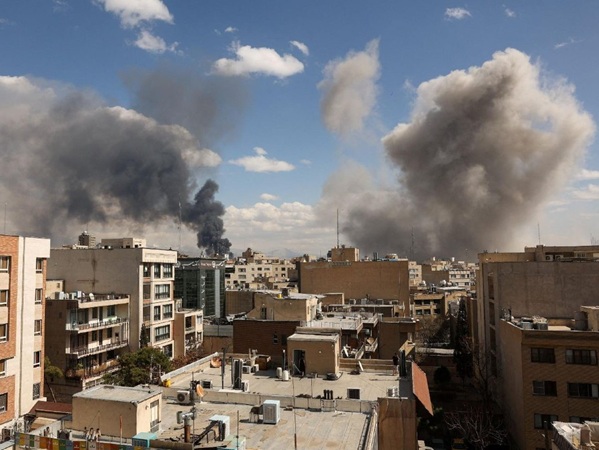
One month ago Trump and Netanyahu launched a brutal war against Iran, with at various times promising to end Iran’s nuclear weapons programme, stop it using ballistic missiles, force regime change, seize the country’s oil, and just two days ago to end Iranian civilisation and return the country to the “stone age”. Trump did not even notice the irony that by the end of the stone age the Persian civilisation extended much further than today’s Iran and was one of the most advanced in the world, already building cities, developing astronomy and mathematics, evolving modern medicine and using irrigation.
But despite his last-minute climb down and agreement to cease fire, not one of Trump’s aims has been achieved, while Iran maintains control of the Strait of Hormuz.
This war was never about creating the conditions in which ordinary Iranians could organise, overthrow the dictatorship and establish a democratic society. Its real aims were to strengthen the control of US imperialism and Israel over the region, including to gain control of the oil and gas supplies, while the Iranian regime was determined to protect its dictatorship. It is further proof, if any was needed, of why a powerful internationalist anti-imperialist movement should be built based on a clear working class political alternative to the capitalist system combined with the real material and political solidarity with those fighting the regime in Iran and elsewhere.
Immediate consequences in West Asia
It is still too early to determine whether the ceasefire negotiated by Pakistan will hold, and what the final outcome of the talks will be. Under pressure at home for failing to meet his objectives in Iran, Netanyahu’s desperate attempt to regain credibility with new brutal attacks on Lebanon is again threatening to force the sides into a new escalation. Despite the White House’s gung-ho claims that it has won a full, with a capital “v” victory, the reality is that US imperialism has been dealt a serious blow.
During the war, thousands of Iranian targets have been hit by tens of thousands of US and Israeli rockets and missiles. It is working class people, their children and all oppressed in Iran, Lebanon and elsewhere whose lives, health and homes are being destroyed by the carpet bombing, while the Islamic Republic blocks the internet, steps up repression, and ensures that no protests against the regime take place.
Trump claims to have been surprised at Iran’s response, even though Iran’s planned response was known well in advance. Unable to match the combined US/Israel military force directly, it has spread the pain across the whole region and to the world’s economy. Since the start of the war, an estimated 1,500 ballistic missiles and 2,500 drones have been fired by Iran at Israel and at the Arab countries.
Despite the obscene military dominance of US and Israeli forces over those of Iran, and their success in killing the former Ayatollah and other key regime figures, they are nowhere near to achieving their political aims – regime change and for the US, control of the oil and gas resources. The US and Israel cannot win this war, as they sink further into the quagmire of a strategic stalemate.
In Lebanon too, the Israeli regime has stepped up its murderous attacks. Since 2 March, over 1,400 people have been killed including 125 children. Whole families have been wiped out. More than a million have been forced to flee their homes. Netanyahu’s refusal to honour the ceasefire and continued bombing of and plan to occupy Southern Lebanon raises the clear threat of the region becoming another Gaza.
While Trump has at least temporarily pushed the Epstein scandal into the background, Netanyahu has stepped up a new wave of attacks on the Palestinians. Since the so-called ceasefire, 663 civilians in Palestine have been killed by IOF attacks, while another 1,700 have been wounded. Netanyahu is trying to starve Gaza with another clampdown on the Rafah crossing. Israeli members of parliament celebrated with champagne and badges in the shape of nooses after passing a new, apartheid law allowing the death penalty for Palestinians.
The false choice between US imperialism and the tyranny of the Ayatollahs
In previous months and years, heroic women, workers and youth have inspired the world by their struggle against the brutal regime of the Ayatollahs. Their anger is now expressed by a worker from Khuzestan:
“in a situation where American and Israeli fighter jets are bombing our homes and lives from such a low altitude, these people [Iranian Revolutionary Guards] have set up checkpoints on every alley and street corner, and have pointed the barrels of their heavy machine guns at ordinary people in the alleys and markets so that they don’t do anything. This is the story of our lives: we must bear the fear of bombardment, reconcile with the empty tables and hungry stomachs of our wives and children, tremble with fear in factories, refineries, and oil depots, and then endure these armed forces at every crossroads.”
The world was horrified by the attack on the children’s school in the first days of the war. Since then another fifty schools and many hospitals have been hit. Thousands of ordinary working class people and youth such as Majid Yulchi and ten more workers at the Payard wheat starch factory have perished under US and Israeli missiles. They join all those murdered by the regime in the last three months – heroic protesters like the female footballer Zahrah Azadpur, 66 year-old Jamileh Shafiyee, 15 year old Benjamin Mohammadi, violin teacher Sanam PurBabaeie, and dentist Mahsa Dezfulian. At least 13 mainly young oppositionists have been executed since the start of the war.
As if bombing schools was not enough, now the Israeli forces are targeting the universities. Sharif University, a top engineering institute was hit in early April. Students there were amongst the first to rise up in support of the Woman, Life, Freedom movement in 2022 and were again at the forefront of this January’s protests.
Israeli bombs even managed to destroy the Rafi-Nia Synagogue in central Tehran.
Victims are being dehumanised
The scale of these deaths – each of them having families, friends and relatives – far exceeds the total of those killed in Israel, US troops and elsewhere in the region as a consequence of retaliation by Iran supported by Hezbollah.
What becomes most distressing for those who lose loved ones is the way in which their sacrifices are weaponised and dehumanised by the sides, whether it is the Iranian regime which exploits the distress of the parents of the children who died after the US bombed the Minab school, or the monarchist supporters of “freedom”, who dismiss those who died as not important “as they were the children of IRGC soldiers”.
Many of those who view this conflict as the horrific consequences of geopolitics, or who support one camp or the other, treat the victims of this hell on earth as pawns who have no role to play as events unfold. In doing so they depersonalise, dehumanise the victims and help the imperialists, the Israeli and Iranian ruling elites to legitimise their brutal attacks.
Aims of the Trump/Netanyahu war
Those listening to Trump’s press briefings and reading his “Truth social” posts leave with their heads spinning, unable to determine exactly what Trump wanted to achieve from this new, horrific war. Despite his claims to “end wars”, in the last year he has launched military attacks on eight countries – Iraq, Syria, Somalia, Yemen, Nigeria, Venezuela, Ecuador and Iran, encouraged conflict elsewhere, and made bellicose threats against other peoples from Greenland to Cuba .
Intoxicated by the success of his “regime change” in Venezuela and claims to have destroyed Iran’s nuclear capabilities last year, he arrogantly believed he could achieve whatever he wanted in Iran. As if this wasn’t enough, Trump and his acolytes claim this is “all part of God’s divine plan”.
As it launched the war, the White House claimed Iran had restarted its nuclear programme, with enough enriched nuclear material to build a bomb “within days” and was developing long-range ballistic missiles capable of hitting the US mainland. Without in any way justifying the actions of the Iranian regime, Trump’s claims do not hold any water.
Rafael Grossi, head of the International Atomic Energy Agency has stated “Iran has an ‘ambitious’ nuclear program but doesn’t have a program for building nuclear weapons”. The US “Defense Intelligence Agency” has said Iran does not have missiles capable of hitting the US, and would need at least a decade to develop some.
Yet echoing the false claims made by Bush and Blair about Iraq’s possession of “weapons of mass destruction” to justify their attack on Iraq, the US and Israel contradict the assessment of the IAEA, saying that Iran has “408 kilograms of 60% enriched Uranium enough to make 11 bombs”.
If this is true, researchers at Illinois State University say, it is theoretically possible to make a bomb using 40 kg of partially enriched Uranium, but it would be the size of a shipping container and have a power of one kiloton – the Hiroshima bomb was 15 kilotons.
Compared to Israel’s nuclear arsenal, thought to include well over 100 warheads with a yield often over 100 kilotons, Iran’s potential arsenal, although it consumes a huge part of the state budget, seems particularly impotent. Indeed many Iranian activists believe that the regime itself, with its militaristic rhetoric and threats is equally responsible for the current situation.
Netanyahu’s “red lines”
Hidden behind the confusion from the White House about the aims of the war was the statement by Omani Foreign Minister Badr Albusaidi. He said, before the US/Israeli attack that big progress had been made in the negotiations between the US and Iran and that they were on the “verge of a deal”. In this context the claims that the unilateral actions by Netanyahu to start the attack were made to undermine any possible deal are credible.
Now after a month, the White House is trying to find an off-ramp. It has not achieved the quick successes it had hoped for, while Iran’s response has angered and destabilised the reactionary regimes of the Arab world. The throttling of the Strait of Hormuz has planted a time-delay bomb under the global economy. Trump’s MAGA fan-club, at least at the top, is showing signs of rupture, while it is clear that his popularity in the polls is plummeting.
Trump has not shirked from insulting and humiliating the US’s allies, but still they squirm and pontificate about whether they will eventually join the war. UK’s Keir Starmer for example claims that the Labour government will not support the war, yet it has sent warships to the Strait of Hormuz and is allowing the use of its airbases such as that at Lakenheath in Suffolk or the Diego Garcia base in the Indian ocean. Senior Labour MP Emily Thornberry now says that these bases could be used “to degrade Iran’s offensive capability” but not for “offensive” purposes.
Netanyahu’s zionist government, though, is still determined to push its aims. It needs to see the destruction of the Iranian state and its ability to compete with Israeli hegemony across the region, preferably by undermining any further detente between Iran and the Arab regimes, freeing its own hands to continue genocide in Gaza, extend it to the West Bank and break up Lebanon and to a degree Syria.
Whether Trump backs down from his ever increasing threats or not, Netanyahu is preparing his “red lines” that can not be crossed in the event of negotiations. First he demands the removal of all the enriched uranium that Iran is supposed to have and then the destruction of Iran’s ballistic missile capabilities. Hidden behind these red lines is his determination to continue the bombardment of Iran’s cities to reduce its viability as a state and regional power, and undermine Iran’s “Axis of resistance”. This, of course, would be a dramatic change in the regional balance of power, with Israeli aims of creating a Greater Israel challenging the interests of the Arab regimes.
The war has further importance domestically. Israel’s global reputation has been severely damaged by the genocide in Gaza. Now, even though the horrors continue in the occupied territories, they no longer feature in global news bulletins. At the same time, Netanyahu is cynically using the war to divert attention from his personal problems – he has challenged President Herzog to drop the corruption charges he faces. His government is trying to resurrect the judicial reforms that provoked mass protests in 2023, and is hoping that pressure for an enquiry into October 7th will ease. With an election looming in the next few months, Netanyahu hopes, so far unsuccessfully, the overwhelming support for the war (81% of the Israeli public supports the Iran strikes, while 63% of those surveyed believe the campaign should continue until the Iranian regime falls) will boost his chance of re-election.
Trump wants the oil and gas
Trump has wanted a US attack on Iran since as long ago as 1980, when an NBC interviewer asked if he was advocating the use of US troops. He replied “Yes”, and if America had done so “I think right now we’d be an oil-rich nation”.
It is this greed for oil added to the rapacity for regional domination that drives Trump’s desire for regime change. From the US point of view, the ideal solution would have been a Venezuelan style of intervention – the decapitation of the regime and a deal with a section of Iran’s ruling elite that would have given the US a stranglehold over the world’s hydrocarbons. This has been verbalised by Trump when he boasts that he and the Ayatollah will jointly control the Strait of Hormuz.
Trump took a big risk in arresting Maduro, possible only because of the degeneration of the Chavismo movement, economic crisis and splits within the government, which allowed the Delcy Rodríguez wing of Chavismo to do a deal with Trump and avoid a mass mobilisation of the Venezuelan working class class against the takeover.
But the Iranian regime differs from Venezuela’s. Based on the Islamic Revolutionary Guard Corps (IRGC), the Quds force, the various intelligence bodies and armed groups, it is at one and the same time a highly developed repressive apparatus ideologically consolidated around reactionary theology as well as having several layers of leadership and decentralised decision making. Ali Khamenei, it is reported, insisted on establishing four layers of leadership so that even when key leaders are removed, it continues functioning.
Since the 1990 turn towards neoliberalism, and then the rise to power of Mahmoud Ahmadinejad in 2005, the IRGC through a complex network of privately controlled conglomerates has gained control of somewhere near 50% of the economy. By 2021 the pendulum of economic power had swung so far in favour of the IRGC and the clerical bureaucracy that an incredible 97% of workers hold contracts shorter than 6 months.
Can troops on the ground bring regime change?
Trump says that he will maintain the military presence in the region, ready for action if the ceasefire completely breaks down. The US already had 50,000 troops based across western Asia and has sent thousands more with the suggestion that there will be “feet on the ground” in Iran. Netanyahu is stepping up the pressure saying “you cannot do revolution from the air”.
The idea, however, that troops on the ground will enable regime change is absurd. At the height of the US invasion of neighbouring Afghanistan there were 110,000 US troops involved. At the start in 2001, the Taliban government was overthrown and Hamid Kharzai’s government installed. When the final US troops withdrew twenty years later the Taliban was firmly back in control. The intervention alone cost over $1trillion.
Iran is a completely different challenge. Its land area is three times that of Afghanistan, almost half of that of the US itself, and its population twice that of Afghanistan. It has a modern industrial, militarised economy with a GDP twenty times that of its neighbour.
The US and its allies have a despicable history of interventions in an attempt to force regime change, not least of which was the 1952/3 Mordad coup, which overthrew the democratically elected Mossaddegh government and installed the reactionary Iranian monarchy. The Pahlavi regime, acting as a forepost for Western imperialism, was so unpopular, and its repression of opposition so brutal, it was overthrown during the 1979 revolution, and the consequent Mullah-led counter-revolution.
More recent US interventions, such as that in 2003, left Iraq in chaos and led to the growth of Islamic State. And Libya, Syria and Afghanistan have ended as disasters. Following the US-led “war on terror” it is estimated that 4-5 million people have died from the after effects.
Unlike Venezuela, Trump does not have a viable alternative government. A split within the IRGC and clergy is not likely, as any sign of weakness on their part raises the danger of a revolutionary upsurge within Iran itself – an outcome that the US and Israel fear more than the continuation of the Iranian regime.
In June last year, and during the first days of this war, western and Israeli agencies promoted the return of the former Shah’s son Reza Pahlavi. Two years ago a survey suggested that maybe a fifth of Iranians would have supported his return, and during January’s protests, chants of his name could sometimes be heard during the evening shout-outs in residential areas. But with his supporters in exile waving Israeli and US flags, many ordinary Iranians, particularly women, appeared to have turned away from the monarchy.
As one commentator explained: “over the years a culture of resistance has built up. In that, to oppose the regime some young people developed illusions – they hadn’t experienced US intervention and life under the Shah. But now they see [the bombs and missiles falling and see] what it really means.” Reza Pahlavi, despite all his talk of secularism and democracy, is in alliance with Trump and Netanyahu, and participates in conferences to promote “national conservatism” together with figures such as JD Vance, Marco Rubio, Viktor Orban, Peter Thiel and other far-right figures.
Even though the new Ayatollah’s Eid of Noruz message called for a “Resistance Economy based on National Unity and National Security”, and the self-proclaimed Shah wants “one nation, one language, one king”, the Iranian people is not homogeneous. Persians are barely the majority of Iran’s population – the other half consists of Azerbaijanis, Kurds, Balochs, Arabs, Turks and Turkmen and others. Both the Islamic Republic and the Pahlavi monarchy are authoritarian projects determined to suppress the ethnic diversity and the rights of all oppressed – workers, women and the LGBTQ+ community will suffer.
Now that the US seems to have realised that Pahlavi would not have widespread support, it has raised other possible figures with whom it could work. The latest is Parliamentary speaker Mohammad Bagher Ghalibaf, a corrupt regime loyalist, who as a high-ranking IRGC leader was responsible for the brutal suppression of the 1999 student protests, as well as the Woman, Life, Freedom movement. He boasts that he rode a motorcycle around Tehran in 1999 beating students with clubs, and has ordered that all women working in municipal offices be replaced by men.
Instead of regime change, chaos!
This leads to the conclusion that Netanyahu in particular, but Trump too, faces a choice: unable to completely defeat the regime of the Ayatollahs, or to find an ally within the country that they can work with, the outcome that will best suit them will be chaos, and possibly inter-ethnic conflict within the country. It is for that reason that Trump urged “the Kurds” to take up a struggle against the regime.
“The Kurds” is in inverted commas as they are not a homogenous group, a chess piece that can be moved at will on the board of geopolitical struggle. Iranian Kurds were first denied the autonomy they wanted under the Pahlavi dictatorship, which viewed Kurdish demands as a security threat to the unified state and met them with severe repression. The rulers of the Islamic Republic simply doubled down on the Shah’s approach. Today’s Pahlavi repeats that: “Iran’s territorial integrity is the ultimate red line”.
Instead, many Kurds, like many Azeris, Balochs and those of other nationalities, suffer from the same issues that affect all nationalities in Iran. This was demonstrated during the “Woman, Life, Freedom” movement, which exploded across the country following the murder of the young Kurdish woman Jina Mahsa Amini.
Reports that the US is already supplying arms to Kurdish groups and urging them to start an armed struggle within Iran demonstrate a cynical disregard for Kurdish rights. The US has a long history of exploiting the Kurds for their own interests and then stabbing them in the back. In 1991 George Bush offered the Iraqi Kurds support if they started an uprising, but when Saddam Hussain sent aircraft and helicopter gunships to brutally put down the uprising, Bush did nothing. Now that the Assad dictatorship in Syria has collapsed, the US has turned against its former partners in Rojava.
Today key Kurdish groups have tied themselves to different imperialist interests – Talabani’s Patriotic Union of Kurdistan has economic ties with Tehran – one of its members is currently President of Iraq, who declared official mourning after the killing of Ali Khamenei. The Kurdistan Free Life Party (PJAK) has close ties to the SDF in Syria and the PKK in Turkey. The SDF, recently abandoned by the US, is gradually integrating its forces into the Syrian army. Barzani’s Kurdistan Democratic Party has met with US diplomats, but stressed he, and the government of Iraqi Kurdistan will not intervene.
While the leadership of Iraqi Kurdistan are reluctant, for the same reasons as the major Arab regimes, to be pulled into the war against Iran at the behest of the US, Iran continues to attack targets in the region it sees as potential threats. By the time of writing there have been over 100 attacks on the homes of Iranian Kurds, the headquarters of the Iranian Kurdish parties and camps housing Iranian Kurdish refugees.
In this context, the recently formed Coalition of six Kurdish parties not only lacks the resources for any real opposition to the Mullahs, but faces the real danger of being torn apart by the different proxy forces and interventions by Syria, Iraq, the US and Turkey, none of which want any form of real Kurdish autonomy within Iran. Many Kurds do not want to be used as pawns in the conflicts between the different regional and imperialist powers, but want to maintain their own agency in defence of their own interests.
Apart from the Kurds, another important and significantly larger minority are the Azeris. Any moves by the Kurds towards autonomy would meet with significant resistance from the Azerbaijani regime of Aliyev, which is closely tied to the Erdogan regime in Turkey.
Gulf states
Even though Saudi former intelligence chief Prince Turki al-Faisal described this conflict as “Netanyahu’s war”, the Israeli-US attack on Iran has raised real concern across the Arabian peninsula. Before the launch of airstrikes on Iran, it is clear that a number of Arab regimes warned and pleaded with the US not to go ahead for fear of the consequences. While Trump claims he was surprised by Iran’s response, Iran for long had been warning that if it was directly attacked it would attempt to widen the conflict across the region.
Now the regimes, who have allowed the US and other imperialist powers to use their territories for military bases, are discovering the cost. Not only is the US not rushing to protect their interests, they are also losing any agency to determine their affairs. After Iran attacked Kuwait, Dubai, UAE, Saudi Arabia, Qatar and Bahrain, members of the Gulf Cooperation Council declared that states “must not be dragged into a direct confrontation with Iran”, but if it occurs it “will deplete the resources of both sides and provide an opportunity for many forces to control us under the pretext of helping us escape the crisis”.
After four weeks of the war, the regimes are overcoming their initial shock. Still trying to avoid being dragged into open conflict with Iran, Saudi diplomats in particular are openly criticising Trump and Netanyahu. Omani Foreign Minister Badr al-Busadi has said that “America has lost control of its own foreign policy”. In calling for a diplomatic solution, behind the scenes they want to see Iran qualitatively weakened but fear it could have become a broken chaotic country creating even more instability in the region.
According to another commentator: “the Arab governments feel betrayed and traumatised, their economies have been set back by 15 years. They are angry at the Iranians for extending the conflict, but also with the US and Israel for precipitating it. The US will now be weakened in its relation to China”.
With the ongoing genocide against the Palestinians and the continuing and escalating Israeli aggression against Lebanon, Syria and elsewhere, any attempt by the Gulf states to join the war on Iran will meet widespread public anger. The “Arab Opinion Index” reported last month that 87% of all respondents across the Arab world oppose the recognition of Israel. Whatever the outcome, the Arab regimes are no longer so confident that the US will protect their interests, so it is likely they will step up attempts to diversify their interests – with China, Turkey and European countries.
Iran’s fair weather friends
Western war-mongers and media outlets such as Fox News highlight the close alliance between Iran, China and Russia. US House Speaker Mike Johnson refers to this as the new “Axis of evil”. Often the liberal media echo this. Yet now that the Iranian regime is facing a war for survival, its friends are staying away.
Since Russia’s brutal invasion of Ukraine in 2022, it has been unable to send support to its allies when they are under attack. Armenia was ignored when it sought help to stop Azerbaijan seizing Nagorno-Karabakh. Former ally Assad in Syria saw his regime collapse without the Kremlin lifting a finger to help. Trump’s forces faced no opposition when they captured Maduro.
China too has been reluctant to be drawn in. Conscious that Trump has adjusted the US’s National Security Strategy (the Donroe Doctrine) to downgrade China as a threat, Xi’s approach is cautious, not wanting to confront Trump in Iran in advance of the latter’s visit, now postponed for a month. The major arms sales deal with Taiwan that the US announced earlier is still being stalled by the White House.
The Pakistan-Afghanistan conflict
A crude assessment of the recent conflict between Pakistan and Afghanistan – Iran’s two eastern neighbours sees it as an isolated binary conflict, sometimes shoe-horned into a geopolitical China-v-US template. Yet the fact that it started just three days after the initial US/Israeli attacks on Iran draws attention to how that conflict is part of the wider regional battle.
Pakistan’s PM Shehbaz Sharif and the military have moved away from previous allegiances and support for the Taliban government in Kabul in favour of stronger links with the Trump regime. The initial attack by Pakistan, which left over 400 dead when a Psychiatric hospital was hit, was justified by Sharif as essential to ensuring Pakistan’s security after Taliban-allied groups had become more active in Pakistan.
The airstrikes and drone attacks were clearly approved and possibly encouraged in advance by Washington, which wanted to warn the Taliban not to move ahead with its promise to aid Tehran in the event of a US attack. The Pakistan military ensured that the former US airbase “Bagram”, abandoned when the US withdrew from Afghanistan, was targeted so the Taliban could not use it.
While the “hot phase” of the conflict was short, Pakistan’s attack firstly warned Kabul to stay out of the wider conflict, and left much heightened tension between the two countries bordering Iran, creating more problems for Tehran.
Now latest events have found Pakistan’s ruling elite in the name of Sharif and Trump’s “favorite Field Marshal” Asim Munir seizing the initiate as intermediaries for negotiations from Oman and Qatar. Undoubtedly Sharif’s friendship with Trump as well as the country’s geographical proximity to Iran, as well as support from China have been key factors enabling it to pressurise the Iranian leadership to accept a proposal, at least temporarily, that allows Trump to retreat from his threats.
Possible renewal and new escalations
If the ceasefire breaks down, one possibility is that US troops will touch ground along the coast of the Hormuz strait, but to do that they need naval support – while the US’s largest aircraft carrier has had to scurry off to a base in Cyprus after its toilets blocked and a fire destroyed the sleeping berths of 600 sailors.
More likely, US troops could attempt to seize Kharg Island, on which the vast majority of Iran’s export capacity is located. At the same time, Trump’s threat to destroy Iran’s energy infrastructure if implemented would provoke a new escalation, and the very threat is provoking the opposition of the Gulf states, who fear Iran’s retaliation.
Any ground intervention though will be at a huge cost in resources for the US. The rescue of one pilot whose F16 was shot down by Iranian forces involved over 100 special forces personnel, and during the operation a further five aircraft – two C130s, two helicopters and a Warthog were destroyed. It has been suggested that the whole exercise, which is estimated to have cost between $300 and 500 million, was in reality an attempt to establish a ground base within Iran to prepare for a full invasion. If so it was an abject failure.
If after a short break there are new escalations, there is a real danger of the Houthis from Yemen becoming more involved. There are real divisions within their leadership. It seems that the experience of its previous limited support for Gaza after October 2023 came at too great a cost in terms of military and civilian losses, as well as to the country’s infrastructure. The conflict also damaged the progress that had earlier been made in developing the Saudi led roadmap for peace in Yemen. For these reasons, there is a strongly cautious approach by a large section of the Houthi leadership, which wants to avoid an open confrontation with the US/Israeli axis. .
Another current worries that by delaying intervention, it will lose out in any post-war realignments of the regional balance of power. If no deal is reached at the end of the ceasefire period this current may become more dominant. If access to the Red Sea transit routes was to be restricted by the Houtis, the damage already done to global energy prices would escalate exponentially.
Economic consequences and a new global crisis?
Despite Trump surrounding himself with far-right sycophants and warmongers, fuelled by fundamentalist calls to prepare for the “second coming of Christ”, it does seem that there are pressures that are causing him to step back from further escalation. The Iranian regime has the upper hand strategically, while even some republican and MAGA hawks are expressing dissatisfaction with Trump’s strategy. Stock market instability and oil prices already over $100 a barrel are also holding Trump’s hand.
In the first month, the US alone has spent $40 billion on the war. To put this into context, during the four years of the Ukraine war, the US has sent a total of $65 billion of military support. Now Trump is asking Congress to commit $200 billion for the Iranian war.
The longer this war continues, the worse the consequences for the world economy. The working class and poor in Iran are already experiencing hyperinflation and deficits, compounded by a collapse of the infrastructure – energy and transport – so essential for daily life. Construction projects have been halted leaving 80-90% of construction workers without jobs. With inflation reaching 2-300% it is unclear how workers are supposed to survive. Not only that, the government is failing to provide any protection, no air-raid alarms and shelters nor any emergency economic planning.
Globally, the International Energy Agency has defined this as the largest supply disruption in history. It is not just oil and gas that are affected; helium is essential for chip manufacturing. 30% of fertilizer supplies travel through the Strait of Hormuz. Countries such as Thailand and Bangladesh are likely to face food shortages, while India and Sri Lanka already face fuel deficits.
Internationally, if the war continues much longer, there will be a new inflationary wave, economies on the brink of recession will be tipped over, and the stagnation affecting some economies will spread. Even if the war were to end immediately, it would take months, if not years to restore the energy resources and refining capacities that have already been destroyed.
The cost to the environment is also practically incalculable. After Israeli bombs fell on Iran’s oil facilities, Tehran was engulfed in black smoke and black rain fell. As a consequence of the Russian invasion of Ukraine, the Israeli attacks on Palestine and the US/Israel war on Iran, hundreds of millions of tons of greenhouse gases have been released, while the transition to renewable energy plans are being slow-tracked as once again hydrocarbon energy is regaining importance.
The real force for change in Iran
The deep integration of the repressive apparatus into the Iranian capitalist state has driven the qualitative and quantitative development of the opposition movements in the last decade. They have been moving in a revolutionary direction.
The Dey protests of 2017/8 and Aban protests of 2019, which exploded after the increase in food and energy prices, respectively, the Woman, Life, Freedom uprising after the murder of Jina Mahsa Amini, and January’s mass protests initiated in Tehran’s bazaar following the collapse of the currency, have grown in scope and met increased repression. In 2017 the protests spread across 75 cities and towns, in 2026, 200 towns covering all provinces were involved. In 2017 4,000 were arrested and 20 died, while in 2026 there have been 26,000 arrests and over 7,000 confirmed killed.
These are HRANA preliminary statistics and could well prove to be a serious underestimate, but even these underline how desperate the regime is to hold onto power, knowing that if it collapses, the masses will demand its brutal oppressors will be brought to justice. It also demonstrates why the protesters have steadily drawn more radical conclusions about what is necessary. No longer limiting demands to an end to price rises and repression, but now demanding complete regime change.
But for now, the imperialist attack has not strengthened the opposition, which is facing even under the sound of bombs a new wave of arrests and repression. The regime is still in crisis, but it is using the opportunity provided by Trump and Netanyahu to maintain and at least temporarily strengthen its grip.
This does not mean that the majority of people are not angry. Despite the extreme restrictions of the internet and other communications, the voices of feminist, worker, and left wing activists from inside Iran can still be heard. Elaheh Mohammadi is the journalist who first broke the story of Jina’s death and funeral. For that she spent 17 months in prison and was again taken in for questioning in February. She writes:
“For more than a month, we have been falling asleep to the sound of fighter jets and explosions, and waking up to those same sounds. And in the middle of all this fear, we try to continue something that looks like ‘life.’
Meanwhile, on the other side of the world, in the middle of calm and comfort, there are people talking about nuclear bombs, as if every explosion here is not already enough to end several lives, let alone a nuclear bomb.
We are literally trapped. Every day we lose the lives of dear civilians. We are afraid, we cry, sometimes we force a smile just to endure. From morning to night we struggle with configs and all kinds of VPNs, and every moment we live with this question: will the house still be standing a minute from now?
For us, war is not just news or political analysis. It is the collapse of life, breath by breath. Your war is our nightly nightmare.
No to war, no to bombs, no to decisions made from near or far about our lives.”
Genuine oppositionists in Iran are angry, at the regime, and at imperialism, but the daily battle to avoid arrest and death is having an effect – in a general atmosphere of caution, confusion and a fear of speaking out, organised opposition has for now to be patient, building in underground conditions, discussing programme and tactics ready to act when conditions allow.
For this reason, a powerful internationalist anti-imperialist movement is needed that is based on the building of a clear working class political alternative able to struggle against the capitalist system itself combined with the real material and political solidarity with those fighting the regime in Iran and elsewhere. Demonstrations against war and militarisation to lobby and pressurise governments to back off from war play a positive role, but they need to be combined with actions aimed at blocking their ability to wage war – pickets and boycotts of military bases, arms manufacturers, and the transport of arms and resources.
It is not surprising that many Iranian activists are increasingly frustrated at the position adopted by many western ‘leftists’ in relation to the war. This mainly refers to the “campists” with their approach that any opponent of US imperialism is an ally. Although this approach flows from Stalinist and Maoist ideology, it has infected those organisations traditionally associated with Trotskyism, such as the RCI which says: ”We stand for the unconditional defence of Iran against the aggressive acts of American imperialism and its Israeli proxies.”
The lip service they pay to those fighting the regime downgrades the importance of their struggle when the Iranian regime is fighting US imperialism. The other camp spread illusions in western imperialism as if it is more progressive, more democratic and less aggressive than other imperialist forces. In Iran’s case they have ended up on the same side as the far-right monarchists.
Other left groups present a programme, carefully honed over decades, that correctly argue that only the overthrow of capitalism and the building of a socialist society can end war, inequality, oppression and poverty. But the programme remains abstract, because its proponents, almost always living in bourgeois democracies, have no understanding of the real conditions elsewhere, and how to build mass struggles against repression and for democratic rights such as those in Iran, or during coloured revolutions, or the GenZ movements. The success of such struggles is essential if a genuine socialist society is to be built.
Each of these groups claim they are implementing Lenin’s approach to imperialist war – revolutionary defeatism. But Lenin stressed that revolutionaries must not halt the struggle against their own governments even if that leads to the defeat of their own country. When the left fails to recognise this, they deprive the masses of any agency in their own struggle – at best leaving it to the socialists in the western countries, and at worst to the military intervention by one or other imperialist force.
The anti-imperialist left needs to listen to activists in Iran to understand why Iranian feminists continue their struggle to overthrow the clerical dictatorship, while opposing the US/Israeli bombing; why Iranian workers are still so determined to fight for their rights irrespective of the bombs falling and repression by the IRGC thugs; or why Iranian queer activists are so opposed to both the theocracy and the anti-trans rhetoric of western imperialist powers. And most importantly having listened, to do everything possible to deliver real solidarity to those fighting in such horrific conditions, to support the building of durable organisations capable of operating despite the oppression, and to help in fighting for a real end to the dictatorship.
Whatever the final outcome of the US/Israel attack and the Pakistan led negotiations, the regime is likely to remain in place. Its structures may be weakened but that only makes its struggle to remain in power more desperate. It will present the fact that it has survived as a victory. It is therefore even more important that the heroic activists who are currently struggling in an extremely repressive society can develop their organisations and win.
Organisations representing busworkers, sugarcane workers, retirees from Iran are clear. They say: “We, the working people of Iran—teachers, nurses, laborers, retirees—gain nothing from war, militarism, bombings, or imperialist policies … It is the ordinary people, especially the working class, who are paying the price with their lives, health, and homes.”
They blame the US and Israel for the genocide in Gaza and the UN and international bodies for inaction. It is capitalism’s drive for profit and imperialism that “are the root causes of war, environmental collapse, and human suffering.”
They argue that nuclear weapons present a legitimate global threat. But international sanctions have been weaponised. The cost is paid by working people, poverty levels are exacerbated, while the regime uses them to divert blame for domestic crises on external intervention, and prioritises limited resources to support the repressive regime at the expense of ordinary people.
They say the binary choice must be rejected. The international workers movement can not support the regime and its military, nor should it support policies that harm ordinary people.
Instead, solidarity should be stepped up to support the civil and social movements that are fighting for the freedom to organise, form political parties and for freedom of expression, for an end to the oppression of women and the LGBTQ+ community, for an end to privatisation and cuts, and for workers and national rights.
Workers organisations in Iran are demanding an end to the bombings, war crimes, and ecological destruction—and for solidarity with the people of Iran and the Middle East in their struggle for peace, justice, and dignity. “No to war. No to Militarism. An immediate ceasefire” is their rallying call and everything possible should be done to support this call.