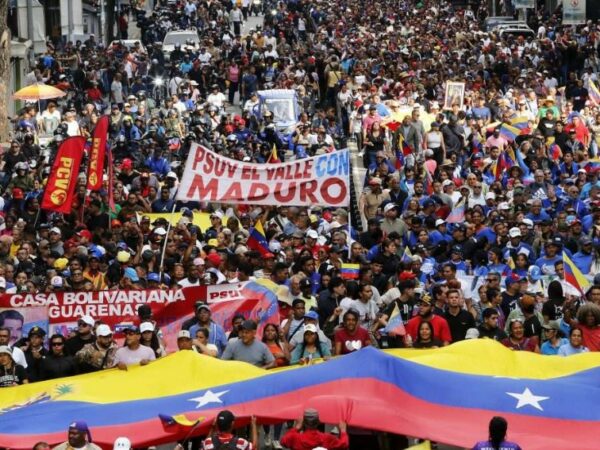
Despite the dramatic U.S. aggression in Caracas and imperialist propaganda, the working class in Venezuela and Latin America has taken to the streets to denounce the kidnapping of Nicolás Maduro. But above all, to defend the gains of Chavismo and the Bolivarian Revolution, and to oppose the threat that intervention represents for all those who dare to challenge the wishes of U.S. imperialism.
Even its financial capital, New York, has witnessed significant mobilizations against Maduro’s kidnapping.
Certainly, and despite the complicity of the corporate media—which for the most part has chosen to ignore the massive protests in Caracas in favor of Maduro’s release—it is a fact that Maduro’s fall did not mean the fall of his regime, the Chavista bureaucracy, or Chavismo itself. As some analysts have pointed out, this amounts to capturing the king without delivering checkmate.
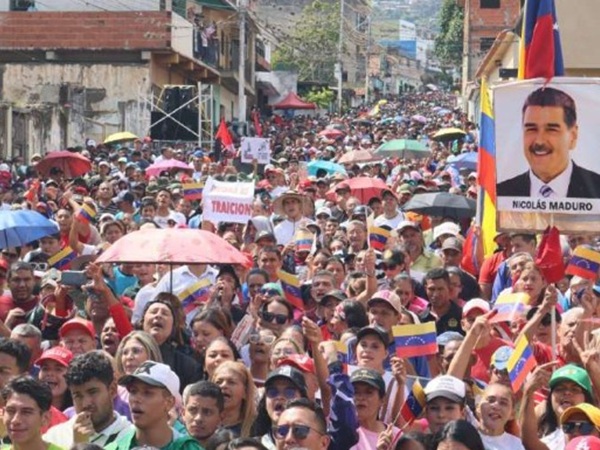
Protest in Trijillo
Trump’s high risk and reckless strategy
Trump’s own announcement allowing Delcy Rodríguez to assume the interim presidency of Venezuela shows that, despite the “surgical” military operation, imperialism does not control the situation. On the contrary, imposing María Corina Machado or Edmundo González could only worsen matters. The very mouthpiece of the U.S. financial sector, The New York Times, rejected the operation in its editorial the day after Maduro’s kidnapping, stating that “if there is one overriding lesson of U.S. international relations in the last century, it is that trying to overthrow even the most deplorable regime can make things worse” (see Trump’s Attack on Venezuela Is Illegal and Reckless).
But what might it mean for a sector of imperialism that things could get worse? To what lessons of the past are spokespeople for the U.S. financial sector referring? The answer is not hard to find, with Venezuela and Chavismo at the center.
On April 11, 2002, imperialism attempted to overthrow then-president Hugo Chávez. However, the mass mobilizations that erupted in Caracas and other cities across the Caribbean country not only halted the coup and reinstated Chávez as president of Venezuela, but also catapulted the radicalization of the Bolivarian process, with the expropriation of companies under state control, the development of communes as democratic organs of working-class neighborhoods that decided which actions or measures to push forward, and Chávez’s own radicalization, which once again placed socialism on the global public agenda.
This explains why Trump has opted for a lightning operation in Venezuela, fearing a prolonged popular resistance led by civilian militias that, despite international discredit and accusations of illegitimacy, defend Maduro’s presidency and his return.
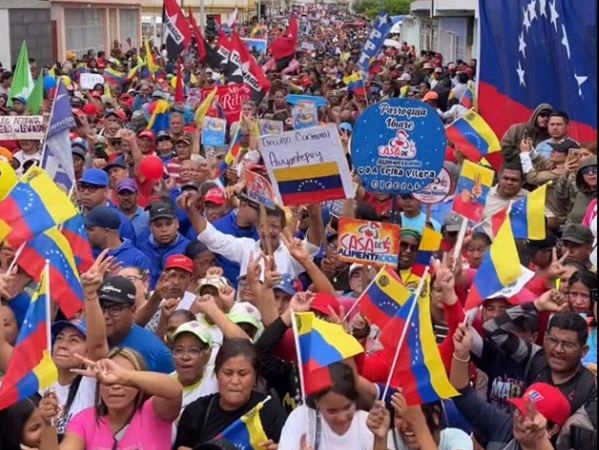
Demonstration in Puerto Ordaz, Bolívar state
Had a direct intervention been chosen, by now the dead would already be counted in the thousands among U.S. army ranks, and the American press would be reporting the transport and arrival of bodies back home, as it did during the catastrophic military adventure in Vietnam and the humiliating fall of Saigon in 1975. Imperialism learns from its lessons, and such a scenario could mark the “enough is enough” moment for Trump and Marco Rubio’s plans in the region.
Chavismo not defeated
It follows from this that Chavismo has not lost control of the situation in Venezuela, despite Maduro’s kidnapping. The latter is largely the result of Maduro’s and Chavismo’s growing international isolation, as well as the deterioration of their image as a consequence of the Caribbean country’s economic disaster, which has forced more than seven million Venezuelans to leave the country in search of better opportunities, turning many of them into a real force of anti-Chavista activists at the international level. This represents approximately a quarter of Venezuela’s population, the vast majority of whom are part of the Venezuelan working class.
All of this means that a critical situation existed in Venezuela even before the aggression, which helps explain imperialism’s reasons for launching it. But this does not mean that the working class has been demoralized or completely dispersed—as might be expected after an attack of this nature and the kidnapping of the president—nor that it has retreated into its homes.

Motorized caravan in Maturin
On the contrary, the mobilization of civilian militias and street protests has grown stronger. Moreover, as never before in the past (not even after the April 11, 2002 coup against Chávez), the opposition has been left practically paralyzed and humiliated, even after Trump’s refusal to support María Corina Machado’s presidency in a possible “democratic” transition. Chavismo, with all the distortions, errors, and vices implied by its leadership, maintains control of the situation in Venezuela despite Maduro’s kidnapping.
Marco Rubio’s statement—“test Delcy”—beyond signaling an imperialist attempt to fracture Chavismo by exploiting the degeneration and opportunism of its leadership and promoting the idea of betrayal, in fact constitutes an implicit acknowledgment that imperialism faces a more formidable adversary in Venezuela: the working class organized around Chavismo. A direct military confrontation with such an adversary would entail a devastating cost for both the United States and Trump’s own political future.
This is, politically speaking, the legacy of Chávez and the movement he engendered in 2002—a legacy that transcends the limits of bureaucracy and party and manifests itself in the capacity for street mobilization and popular organization through communes and communal assemblies—more than 40,000—willing to defend any prerogative against U.S. imperialist policy and attempts at betrayal within the PSUV leadership and the government.
In this context, it is pertinent to ask, beyond the fruitless theories about an alleged betrayal within the presidential cabinet or a negotiated exit for Maduro, what the rise of a powerful anti-imperialist movement in the streets means for the Chavista bureaucracy, U.S. imperialism, and even Latin American progressivism in the face of recent aggressions and those yet to come.
This is the same question that was resolved by the popular outpouring in defense of Chávez after the 2002 coup, and which today once again stands at the center of political debate in light of the limits and contradictions of state policy and the institutional framework of bourgeois democracy.
On the one hand, it is undeniable that the Chavista apparatus has undergone a deep process of degeneration and exhaustion, which partly explains Trump’s aggression—or, as one maxim of the art of war puts it, weakness invites aggression.
This also explains the call by Diosdado Cabello himself, once an opponent of Maduro for leadership of Chavismo, in the very early hours of the bombing of Caracas and Maduro’s kidnapping, to “not make things easier for the enemies.” In simple terms, Diosdado called for the paralysis of the mass movement and for leaving in the hands of the Chavista bureaucracy the decision over which actions to take to defend Maduro—at the cost of his transfer to enemy territory.
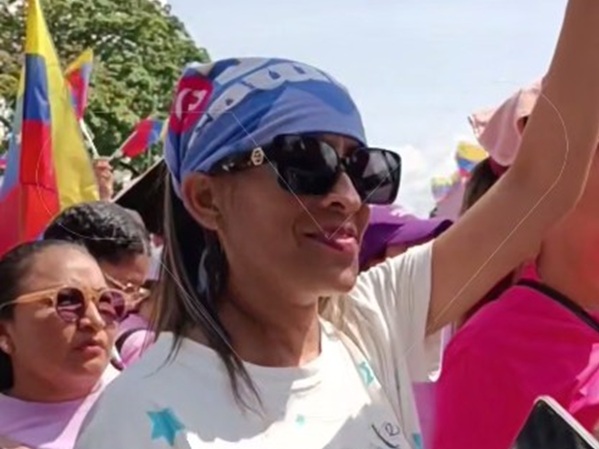
Womens’ march in Caracas
The development of the mass movement, as in 2002, would not only have stopped Maduro’s kidnapping cold but would have pushed the Venezuelan process further to the left, placing not only imperialism but also the Bolivarian bureaucracy responsible for the catastrophe under pressure.
The beast with feet of clay
Both in Venezuela and in the United States, the Bolivarian bureaucracy and Trump himself are trapped at a crossroads in advancing toward a new phase of the plan of control and encirclement.
On the one hand, the Trump administration is constrained by the still-unfolding consequences of the operation amid growing internal tensions: midterm elections overshadowed by the Epstein scandal, fractures within the MAGA movement, growing denunciations and mobilizations against immigration raids, and the victory of democratic socialist Zohran Mamdani in the financial capital of U.S. capitalism—a signal that deeply unsettles billionaires and both the Republican and Democratic establishments.
The attack on Venezuela and Maduro’s kidnapping constitute Trump’s riskiest political gamble so far, aimed at recovering eroded legitimacy, even more deteriorated than during his first term, when he lost re-election to Biden, and a level of disapproval below that with which Biden himself ended his presidency. According to Forbes magazine, Trump ended 2025 with an approval rating of 39%.
Added to this, since the start of his second term, the Republican Party has lost every local election held so far, including Miami, while its social base—the MAGA movement—has weakened and the rift with a growing sector of Republican lawmakers has widened.
The imperialist adventure in Venezuela, as well as threats directed at Cuba, Mexico, and Colombia, may represent a brief respite for Trump and Rubio ahead of the upcoming November midterm elections, while they attempt to bury their ties to Epstein in silence and reunify dissensions within their own cabinet.
If this objective is not met—and all signs indicate the outcome is moving in that direction—their administration could plunge into irreversible disorder, besieged both by its own parliamentary allies and by domestic and international pressure against the erratic behavior of a declining imperialism. Just days after the attack in Caracas, the U.S. Senate has already voted against Trump, with the support of five Republican senators, blocking further military actions against Venezuela without congressional authorization.
At the same time, it is evident that Maduro’s image will be strengthened—not only within Venezuela but across the Latin American and global left—as a hostage of imperialism. And with it, the regime of siblings Delcy and Jorge Rodríguez. All the more so as the latter has announced the release of at least several hundred political prisoners, including Enrique Márquez, former candidate of the Communist Party of Venezuela.
At the same time, this will call into question both the unilateral actions of the Bolivarian bureaucracy and those who, under the supposed defense of the Bolivarian Revolution, have silenced criticism of bureaucratic measures.
The response of Latin American progressivism
The reactions of Petro, Boric, Sheinbaum, and Lula were swift, denouncing the unjustified aggression and condemning U.S. attacks as flagrant violations of agreements and international law—now practically emptied of content.
Nevertheless, it is evident that the capacities—and even the political will—to respond effectively to this challenge are scarce. Verbal condemnations have quickly been relegated in the face of Trump’s response, materialized in new threats of military incursions and trade sanctions. Latin American progressivism must recognize that it no longer faces the “classic” imperialism of the neoliberal period, but rather the starkest expression of a declining power that openly proclaims Latin America as “its hemisphere” and “its backyard.”
In this scenario, the future of democracy and the survival of progressive projects depend on the real ability to build solid regional integration on the commercial, political, and military fronts against a giant with feet of clay—a hegemony that, in its agony, resorts to violence as the last support of its domination.
In the eyes of millions of Latin Americans, the need becomes evident to form a regional bloc for defense against imperialist aggressions and as a counterweight to attempts at economic and commercial subordination to the U.S. market—one that allows the region to finally break its dependence, on the road toward a socialist federation of Latin America.